Random escapes from the humdrum of existence.
Methods used: culture, travelling, and little pretty things surrounding us. Sometimes giving way to anxiety about the environment.
Culture spring is warming up even though the weather is not. In this week's programme: ballet. I'm not a huge fan of traditional ballet with colourful costumes and too much happening on the stage. This time, the National Ballet of Finland was offering something very different and exactly for my taste.
The evening was composed of three diverse pieces. First, George Balanchine's "Four Temperaments" was a dream-like beautiful ballet that was considered ahead of its time when it was made in the 1940s and it still seemed modern.
The second piece was William Forsythe's ballet "In the middle, somewhat elevated" that he made in the end of 1980s. At this point, Balanchine seemed already a bit traditional, but I wasn't greatly moved by this fast-moving and almost rough dance.
The last piece was extraordinary. It was Jirí Kilián's "Bella Figura" (watch the whole thing below) and I loved it, completely loved it. Beautiful baroque music (a new discovery was Pergolesi's wonderful "Stabat Mater Dolorosa") combined with amazing choreography. Even though I'm normally more amazed by humans' capacity to destroy our planet and act like idiots, watching the ballet dancers on stage, I felt that the human potential for creating something beautiful is truly unlimited.
Not only the choreography was fantastic, but also the fact that the human body can move in such amazing ways and, at the same time, translate to the audience in body movements some very human feelings and our insecurity and vulnerability. The dancers were like broken dolls on stage helping one another to feel better or survive. Maybe the message was that we are dependent on others and that we should care more about them. At one point it is me who needs help and, at the next one, it is the other. I felt that there was a beautiful connection and solidarity between the dancers on stage or the roles they were playing.
I had tears in my eyes at the end and I wished that the dance would have continued and continued. My friends agreed!
August is definitely the best time to visit Helsinki and it competes well with Berlin, Copenhagen or other trendy cities as a travel destination. Helsinki has been full of art, design, music and performances during the last couple of weeks (hence, no blog posts about my trip in Africa). To be honest, the city offers perhaps even too many cultural activities in August. The quality of the Helsinki Festival (17.8.–2.9.2012) programme is always very high and I can guarantee that what ever you choose, you will be satisfied.
I started the festival with a concert of Madeleine Peyroux, a former street singer from New York. She has a great raspy voice and makes wonderful versions of Bob Dylan and Leonard Cohen songs as well as her own songs. She started the Huvila tent concert with Cohen's 'Dance me to the End of Love' (see below); coincidentally, Leonard Cohen started his own concert (a couple of weeks later) with the same song. Peyroux made fun of her own choice of sad and melancholic songs but I couldn't think of anything more suitable as the autumn approaches us and the evenings are getting darker. Wonderful concert.
The very cool and relaxed Art Goes Kapakka (art goes to a pub) happening brings live music and other forms of art in various pubs and restaurants in Helsinki. During ten days and ten nights, there were more than 300 events (free of charge) in Helsinki. I heard some sentimental indie folk by Selja Sini and Finnish klezmer by Narinkka. Considering the overwhelming cultural supply in August, I just wish that this event took place later in the autumn when the parks are too cold to accommodate (culture-) thirsty hipsters.
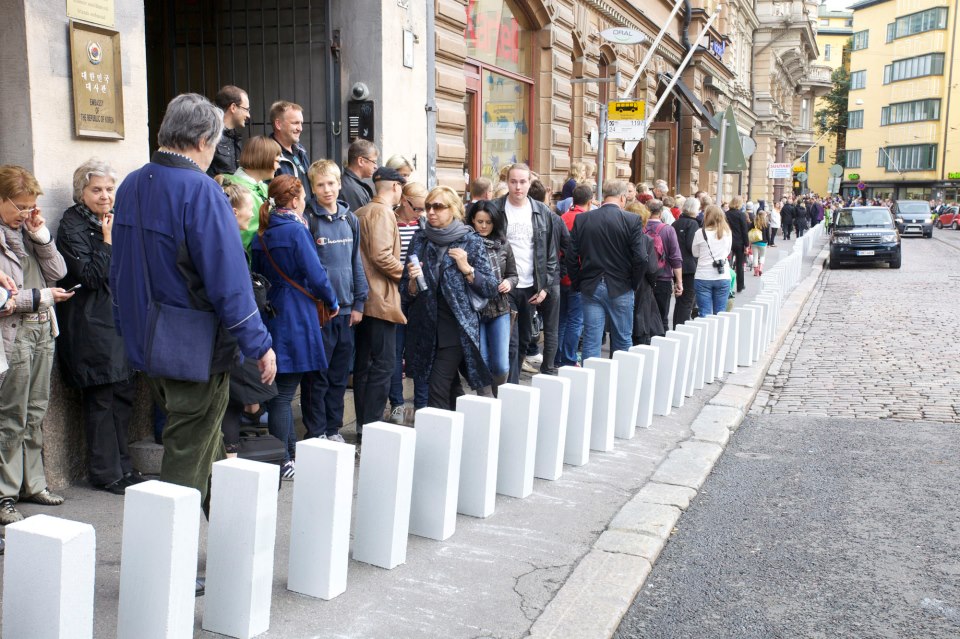
As with Taiteiden yö (the night of the arts), the AGK is a great way to bring art to all people regardless of the ability to pay. The city seems to be full of people – young and old alike – eager to enjoy art in all forms. During the night of arts, I first listened to some Ugandan music, then followed the amazing Domino chain going through the streets of Helsinki (see below) and finally listened to beautiful Argentine tango songs in my neighbourhood library. The idea of the night is that culture and people meet in unexpected places in unexpected ways. It works: the atmosphere in the city was really nice – I hope it could continue this way in the winter time as well.
All the Domino photos by Helsinki Festival (Facebook).
Certainly, the idea of the domino chain was very simple. However, the way it brought excited people together was really cool. Thousands of people had congregated in the streets to follow the chain of blocks falling down. I could hardly see the blocks when the 'chain tumble' passed me, but I got emotional (in a somewhat hilarious way) by the idea how art can create such a sense of community. Bravo!
People following the Domino in Senaatintori.
The final part of the Domino.
One of the highlights of the festival was the magnificent Monteverdi concert in St. John's Church. Rinaldo Alessandrini (also in the video below) conducted the Helsinki Baroque Orchestra and choir in a brilliant version of Monteverdi's Vespri della Beata Vergine from the early 17th century. I got goose pumps and tears in my eyes immediately when I heard the powerful first notes. There is a feeling of perfection in Monteverdi's music – almost as if he had received the notes straight from God.
This music makes me believe in gods.
One great thing about the Helsinki Festival is that they introduce a lot of good artists to people who don't follow the happenings in the art world so closely. I found out about this cool young Belgian singer Selah Sue that has sold tens of thousands of albums in Belgium and France. She was indeed very talented and I'm sure we'll hear more about her in the future. She had a great voice and an original style (see below), a mix of funk, soul and rap in the footsteps of Lauryn Hill, Erykah Badu and other great female voices of the recent years.
In addition to these, I enjoyed classical music in the Helsinki Music Centre with Gewandhausorchester Leipzig conducted by Riccardo Chailly. They started with Mendelsshon's Violin concerto e-minor 64 (Nikolaj Znaider playing the violin), again unforgettable first notes (another version by Isaac Stern below) and obviously there was the sound of history and great tradition in the air as the orchestra in question was once conducted by Mendelsshon himself.
Last one of my concert experiences was a piano concert by Pierre-Aimard Laurent (below in the photo) visualised simultaneously by a British artist Normal Perryman (see video above on his "live kinetic painting"). While it was difficult in the beginning to follow both the music and the images reflected on the screen (done on the overhead projector with colourful paints), I then understood how the two forms of art complemented each other. A fabulous experience once again.
Both photos from Helsinki Festival website.
After these overwhelmingly powerful cultural experiences, I can't help thinking of economy. In the middle of an economic crisis and budget cuts, I am extremely sorry that governments don't seem to understand the value of culture to the well-being of people and the beauty of life. More culture – less wars, unhappiness and anxiety.
It is easy to oppose subsidies to opera or theatres when jobs are at risk, but I can’t think of a more woeful society than a society without a wealthy variety of culture. It’s the end of our civilization if only profitable forms of culture can exist (Angry Birds and other video games?). It will make the selection in our libraries very poor if only best-sellers can be written (Da Vinci Code and Paasilinna?). Somehow, I wish no democracy in culture, if it means that I must read and watch what the majority is reading and watching.
I've been working from 8h30 in the morning until 20h, 21h or 22h in the evening due to the desperate attempt to finish my PhD thesis by Christmas. Therefore, my enjoyment of Florence has been restrained to speeding through Piazza SS. Annunziata and having a glimpse of the Fiesole hills surrounded by thick grey clouds before reserving my desk at the library.
Bronzino: Portrait of Eleonora of Toledo and her son Giovanni. A painting of Cosimo de Medici's wife and son; Eleonora's brocade clothes look so real you wanted to touch them and her face so undecipherable that you wanted to be her best friend.
Though I had detailed a long to do -list for the weekend, I didn't have the force to sit by the computer anymore (well, here I am again!). At the market I bought gorgonzola, pecorino stagionato, fresh pasta filled with artichokes, asparagus cream, red pesto sauce, and flowers – I decided that I have to make the most out of these last three weeks in Florence.
I started by visiting the Uffizi gallery in the afternoon before a concert at the Teatro della Pergola. I had been waiting for November and the end of the tourist season to get in without queuing. It was already my sixth time in the museum, but it's still not enough to give all the paintings the contemplation they deserve. On this occasion, I only wanted to spend some quality time with my favourite pieces. Sandro Botticelli's Primavera and The Birth of Venus are of course one of them. A couple of weeks ago, I actually felt personally a bit offended when a friend of mine said that she preferred seeing them in an art book. Of course, the colours might have faded but standing in front of these absolutely beautiful masterpieces is something completely different from sitting on your sofa and flipping through your copy of "1000 art works you need to see before you die" (by the way, if this book exists, I want it for Christmas). It's like my dad who says: "Why should I travel abroad if I can see all the different places in the world on a TV." I actually didn't like Renaissance art before coming to Florence. It is not necessarily as accessible as Impressionism, but now, after three years of indulgence in Florentine art through visits in the museums and churches, I can define myself as a Renaissance lover and I would like to call myself an aficionado. Things were not always like this, my first visit to Palazzo Pitti's wonderful collection was with a charming intellectual who wanted to share his love for Caravaggio and other great masters with me. However, I was feeling sick because of the lack of air condition and the drinks the day before and I could only focus on the slightest currents of air every now and then. Instead of art, we had pizza slices in the garden of Boboli.
But yesterday, in front of the majestic Madonna and Child and Two Angels by Filippo Lippi (above), I almost wanted to cry. The beauty of the work and the realisation that soon I wouldn't be able to admire these amazing paintings hit me. I stood in front of the Madonna for a long moment as if to memorize the lines and colours of it by heart (I later also bought a post card and book on the Uffizi gallery to help me with this task). By the way, it's probably no coincidence that I find the women in both Botticelli's and Lippi's works so beautiful and serene as Filippo Lippi was Botticelli's teacher.
Today, I continued my cultural exploration and visited the exhibition dedicated to a later Renaissance painter Bronzino in Palazzo Stozzi. Coincidently, I had seen an exhibiton of his drawings earlier this year in the Metropolitan Museum of Art in New York where they had managed to collect almost all the existing drawings by him. But this was a first ever exhibiton of his paintings. Bronzino (1503-1572) worked in the Medici court and was also a poet and a member of Accademia Fiorentina. Already after the first room of the exhibiton, I knew that he deserves a place in the same category with Michelangelo and Leonardo da Vinci, and perhaps after this great exhibition he will be acknowledged as one of the great masters of the Renaissance and not only a peculiar mannerist. He also seemed to have a good sense of irony as shown by his work of the Medici court's dwarf (below).
This double-sided painting was Bronzino's reply to the on-going dispute about the primacy of different art forms. His contemporary, Benedetto Varchi had solicited that sculpture was the most noble of all arts. Bronzino responded with Portrait of the Dwarf Morgante that can be placed in the middle of the room as a statue but moreover, it can depict more than one time dimension. Hence, one side shows Morgnate going to hunt birds and the other side illustrates him afterwards with his pray. As a curiosity, the bird in front of Morgante's private parts was painted later by an unknown painter.
When seeing the magnificent tapestries that Bronzino designed and Flemish masters wove for the Palazzo Vecchio in Florence, you couldn't help but wonder how they were done and how they had survived five centuries. Indeed, this was the first time after the 1980s that they were on public display. These tapestries and their restoration provoked a little dispute between me and my historian friend who joined me for the exhibiton. She considered restoration of art as an act against the normal flow of history. If art creations deteriorate (and they do), we are not suppose to restore them. Art should show the signs of time, she argued continuing that restoration is like a translation of literature, it can never offer the exact same feeling or represent the original work fully. In contrast, I felt this was complete non-sense; the majority of the works on display in this exhibiton wouldn't have been there at all without some restoration or they would have been only a shadow of the things we were currently examining. The whole preparation of the exhibiton had been accompanied by difficult and important restorations. In fact, I think we have the responsibility to restore the works of art for the future generations before they are ruined forever. Obviously, there's a chance that something of the original piece will get lost even with high standards and modern technologies, but to refer to her analogy on literature, I rather read the Finnish translation of Crime and Punishment than not read it all (or study Russian for ten years to be able to read it in its original language / build a time machine so I could see the paintings when they were still fresh of recently applied paint). However, I do not agree with Berlusconi on giving the antique sculpture of god of Mars his manhood back in the form of magnetic and removable penis (probably I wouldn't agree with him on anything else either).
This was acually on display at MET, it's a design for the tapestries that we saw now in Palazzo Strozzi.
One of the great works of Bronzino Descent of Christ into Limbo (below) was restored after it was badly damaged in the 1966 floods. It wasn't on display at the exhibition but the copy of it in my new Bronzino book inspired me to go to the Church of Santa Croce to have a look of it. It's a powerful painting where Christ is saving the souls of the unbaptized. Bronzino had basically depicted all his entourage in that painting, among which himself with the blue robe behind Jesus and some of the most beautiful young ladies of Florence. Obviously resulting in a scandal in those days. Raffaello Borghini, an important Florentine, criticized it because of the "figures excessive nudity, sensual poses and supple limbs, and very fair colours" that would distract the uncultured from prayer. Not to mention the modern cartoon-like monsters in the top left corner. But the women are purely beautiful and each face is paint with such a painstaking attention to detail and naturalism that Bronzino was so famous for.
A detail from Descent of Christ into Limbo.
Indeed, Giorgio Vasari, the art authority of the time and the writer of "The Lives of Artists", which could be considered as the first art history book in the world, already wrote of Bronzino's portraits: "They were all very natural, executed with incredible diligence, and finished so well that nothing more could be desired". Below is a portrait of Cosimo's illegitimate daughter Bia who died already at the age of 6. This was one of my favourite portraits in the exhibition.
Conclusion of the weekend: it's always so much easier to get inside an artist's head or a moment in history of art in general in an exhibiton with a more focused theme. While I believe that Uffizi gallery is one of the best museums in the world, even there the collection spanning from Giotto to da Vinci and Tintoretto, or from Christian art to the full bloom of Renaissance and Venetian masters, is sometimes too much to grasp (hence the limited focus of my last visit). I never get to Venetian masters or Caravaggio with some energy left and this is only the history of Italian art during around 300 years. What about Louvre or MET: in one afternoon you go through Egyptian art and Impressionists with a deviation to Asian culture. What kind of sadist built these museums? Small is beautiful – and intelligible.
Half a year in Berlin without being/becoming a hippie artist – how did we do it? I recently read an article in Time magazine (Nov. 16, 2009) about the hip Berlin and how artists, designers and writers are transforming the German capital. Based on the article you could think that there is nothing else than bohemian creative people developing the countercultures in this city. “Berlin is like Paris in the 30s”, “Berlin is like New York in the 60s”, the designers moved from other European countries were saying (somewhere else I read that Berlin is like New York in the 80s).
I didn’t really get indulged in this artsy scene, and having read the article I felt like having missed something essential of the city. Now that we only have one week left in Berlin it’s time to do the closing of the books: should I have made more wanna-be actor friends?
Despite a couple of things (such as smoking in the bars and tipping system), life in Berlin is a great and high-quality combination of culture and ecological living. The two things I appreciate the most in this city.
1.) Culture: Latest Discoveries. - Little concerts all around the city every day. Even without artsy people as friends you can freeride and enjoy their concentration to Berlin. I especially fell in love with a Norwegian singer-song writer Sandra Kolstad in one of these randomly chosen events. - Gemäldegalerie. As we are surrounded by modern architecture and innovators in contemporary art, Gemäldegalerie (picture gallery) is a great escape offering an outstanding collection of old European art from especially Dutch and Italian masters. - With a huge selection of what to do and see, you are also bound to make bad choices every now and then. This was the case when I found myself watching a 2-hours long performance that was supposed to be a dance but where dancers were hardly moving (=boring!). To be honest, I was wondering if the piece got some public money and I hoped not – my 12 euros were already too much.
2.) Ecological Living - Biocompany. With an organic food shop in every neighbourhood ecological consumption is easy and not that expensive either. Germany is definitely a forerunner in these things. -Bike paths. While in my home city Tampere, the development of cycling lanes was impossible due to the extensive criticism based on non-sense, in the ten-times bigger Berlin, biking is a pleasure: good separate biking lanes, cars giving way, and with thousands of other bikers you are not alone.
One week to make the most of Berlin. I’ll let you know if I made my way to Museuminsel, Emil Nolde Museum, rave party, Brücke Museum, second-hand shops, Mauerpark flee market, Sunday brunch, jazz concert, or Charlottenburg. I don’t have time to have artsy friends; I have 160 museums to explore…