Showing posts with label travelling. Show all posts

Sunday, 5 April 2015

An eye-opening escape to Iran - to be recommended!


When I told people that I was travelling to Iran, I got basically three types of replies:

1) "Why?" (negative)
2) "Why?" (curious)
3) "I'm jealous."

It was hard to reply to the comments, and especially to convince the people in the first group, as I knew so little about the country before going there. However, now back from our two week trip, I feel like responsible of spreading the message of this country and namely of its people who left me with a great impression of Persian hospitality, history and culture.

While the concert of Azam Ali (see video below) in Helsinki Festival last August was perhaps the concrete push for me to travel to Iran, it was also an exciting destination because most of us know basically nothing about Iran - except something negative related to nuclear power and strict Islamic state - and we have such huge prejudices against Iranians. Traveling to Iran was truly an eye-opening experience and also an interesting dive into Iranian/Persian history and Islamic culture.


Many people make common mistakes when thinking of Iran, so I'd like to stress three points:

First, traveling in Iran is safe. It is a surprisingly (for us who don't have much prior knowledge) developed country (no. 71 in the list of countries by GDP per capita before e.g. Thailand and Serbia) with a well-functioning infrastructure, highly educated people (everybody has studied engineering) that can all cite their national poet Hafez, and an important middle class that will make you feel ashamed if you are not prepared with a fashionable city garderobe. 

Don't mix Iran with its neighboring countries, it is nothing like Iraq or Afghanistan, while the bordering regions in Iran might better be avoided. If Islamic state is authoritarian, it has at least managed to keep the country calm and somewhat prospering even despite the sanctions. Of course, there is always a possibility of violent demonstrations that you want to steer clear of. Crimes against tourists are  however very rare and traffic is probably the most dangerous thing you'll be faced with.

Second, it is definitely worth visiting Iran. In addition to  beautiful Persian carpets, the country has plenty of historical sites, amazing Islamic architecture and design, good food and wonderful mountains. Two weeks is hardly enough to visit the country, we only had a glimpse of the central part of Iran. 

Our itinerary including the cities of Tehran, Shiraz, Yazd, and Isfahan is very typical for such a short trip and it serves as a great introduction to Iran, but I still have a craving to visit many other places (especially the city of Tabriz, and experiencing over-night stay in the desert and hiking in the mountains).

Walking in the streets of Tehran or Isfahan, you sometimes wonder if you're still in the Middle East: teahouses are full of hipsters (the Iranian guys are the true "lumbersexuals"), families gather in parks for a picnic, people take selfies with their iPhones, and public transport is clean and efficient. However, at the same time, you feel the strong presence of Eastern culture, Islam, and ancient history that will mesmerize you.

Third, please, make a distinction between the official regime of the country and its people. I've never felt more welcomed in any country I've visited. The Iranian people, young and old, are genuinely interested in discussing with foreigners, asking constantly our opinion of the country and its inhabitants. This offers a great opportunity to talk with various kinds of Iranians. Sometimes language barriers hindered any real conversation, but the message was clear: we were most welcome in Iran. 

The Iranians were also eager to show us a different image of Iran as they are well aware of the one-dimensional idea we often have of this country. People initiated discussions on politics and religion, sometimes shaking their heads to the mullahs and demonstrating their wish to come to Europe, but also being proud of their ancient culture and long tradition in science and arts. Some youngsters were open about their secret parties while some older people recalled their time in Europe decades ago, drinking wine and working hard. 


We happened to be in Iran during Now Ruz, the Iranian New Year, which meant that the majority of Iranians were on holidays  exactly the two weeks we were there. In Tehran, this meant that most of the restaurants were closed and the streets were empty of cars. It was good for the quality of air as Tehran is said to be one of the most polluted cities in the world, but at the same time, the city was a bit boring, not the metropole we had expected it to be. Elsewhere in the country, hotels and tourist sites were busy, but this didn't bother us as it created an even greater opportunity to meet a lot of local people. 

And yes, we did meet people. In fact, our holidays was a good introduction to what it probably feels like to be a Hollywood star. I called our vacation as "the Angelina Jolie experience" for all the photos that were taken of us, all the nice smiles, all the people interested in us in general, and all the people wanting to have a chat with us. I don't know how to live without this limelight again...

Because of the Iranian New Year holiday, all the places were full of Iranian tourists. We didn't mind!


However, to be honest, in the end, when we were already able to go through the basic questions in Farsi, we started to struggle with all the attention we had. Suddenly, the locals seemed almost maniac in their approach to us. However, this doesn't diminish the appreciation we have for the hospitality and friendliness we experienced. I was basically smiling all the time because of these wonderful encounters. 


It is also important to note that Iran is not an Arab country and it differs from the experiences people may have in many other countries of the region. Moreover, what is relieving for a tourist, is the fact that people don't expect anything in return for their friendliness or for helping you. Not once were we asked to pay for random people showing us a way to restaurants or giving us a tour in a mosque or some other site. This is a complete contrast to the experience I had in Egypt where everyone asks for a "baksheesh" even for the smallest thing like opening a door. This is probably connected to the higher living standards (and pride) in Iran, in general, we could only see a very few beggars in the streets (less than in Brussels, for sure).
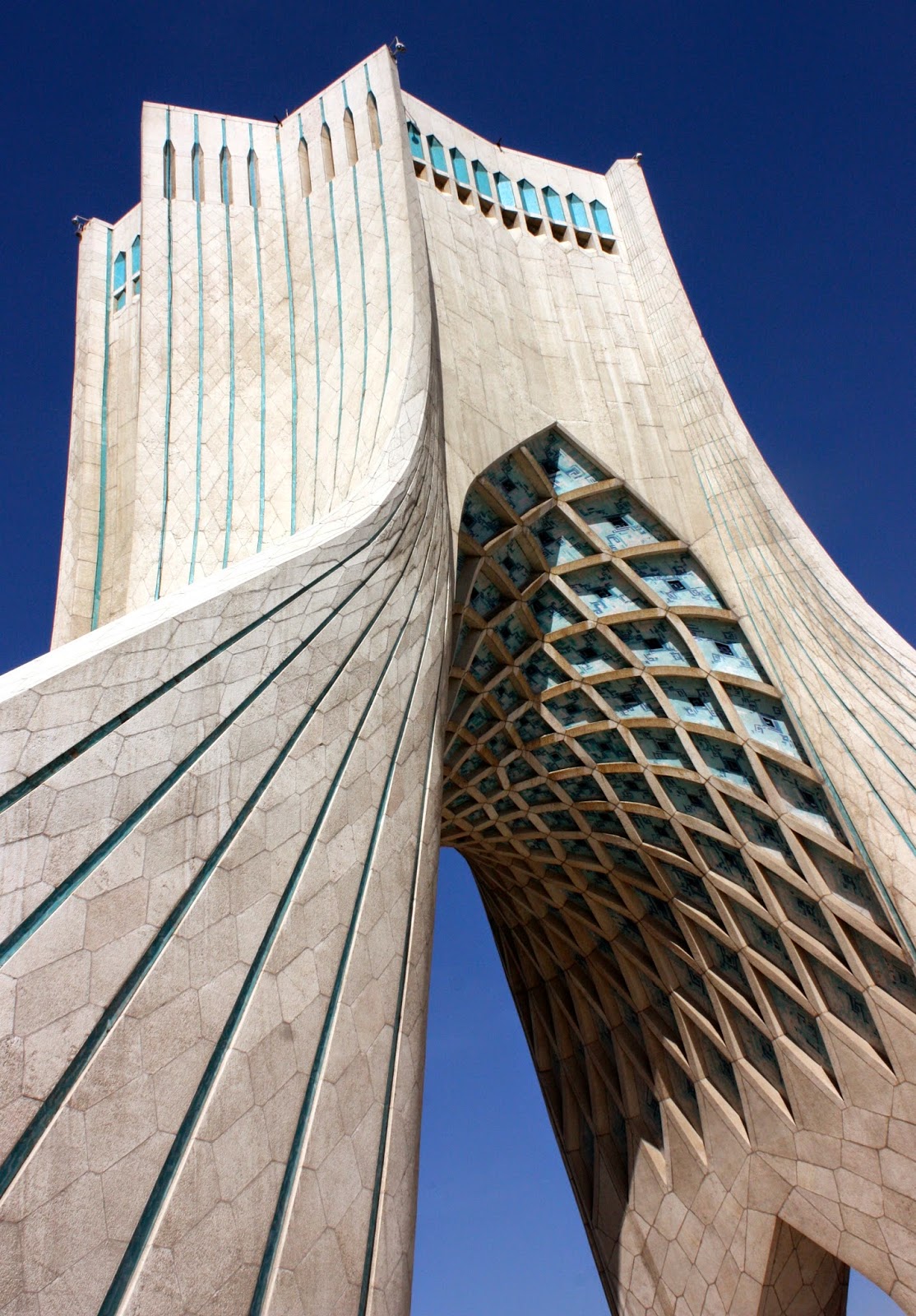
The Azadi tower in Tehran.

The Iranian politeness can also be troubling sometimes. The system of "ta'arof" means that every situation is heavy with small talk and polite praises. It also means that when the Iranians invite you over for a dinner or to stay with them instead of a hotel, you need to say "no" at least two or three times before accepting if the offer is made again and again. Once we finally accepted a dinner offer and it was truly fantastic to enjoy a home-cooked meal with an Isfahan family. It is an experience that should definitely be tried on a trip to Iran. Sometimes it is good to just let go off the European way of calculating the "effort, pay-backs, and debts", and just say "yes".


Without a doubt, there is something we can learn from the Iranians; first of all, we could follow their example of warm hospitality and curiosity towards strangers. What can be better in fighting prejudices and intolerance, and striving for greater intercultural understanding and even peace. Only a cold-hearted person would like to have sanctions against the Iranians after meeting them in person. 


Woman in Masjed-e-Jameh mosque in Yazd.


Monday, 10 March 2014

Burmese Days


Time to write down a few words about my trip to Burma - my amazingly great trip to Burma, or Myanmar as the country is nowadays called.

Ah, these pink shoes are made for traveling - just looking at them makes me wanna go go go!

I wanted to travel to Burma before it's spoilt by other tourists (because I'm a better tourist, of course...). Indeed, the Myanmar government wants to increase the number of tourists to 20 million per year in the near future. I didn't want to see another Thailand (the likely future if 20 million of us go there annually), I wanted to see a country that people had told me to be like Vietnam two decades ago - lush forests and uncrowded sights with authentic atmosphere.

It was also interesting to visit the country just now when it's going through massive changes. The country is opening up in such a fast pace that my Lonely Planet from 2011 was in urgent need for an update. The New Yorker article The Burmese Spring from August 2012 also felt a bit old in some facts, although it gave a good overview of the political situation in the country.

Another obligatory travel reading was obviously George Orwell's critique of colonialism, the novel Burmese Days. The introduction to my edition of the novel was written by Emma Larkin and it had some interesting insights to the book that is partly based on Orwell's own experiences in this British colony in the 1920s. Larkin writes that Orwell's later books also mirrored Burma's recent history and some Burmese intellectuals actually call him "the prophet". Retrospectively, one can argue that Burmese Days, Animal Farm and 1984 form a trilogy portraying Burmese historical events from colonialism to socialist revolution and finally to dictatorship and dystopia. Luckily, it now seems that another epilog can be written to the story. Luckily, because the country has so many things to offer - let's see if I manage to post some more stories and photos here in the near future.

Great anti-colonialist travel reading. Several people also sell it in Burma, but don't be taken aback by these sellers, it's a great read!

Logistics...

I first wanted to travel to Burma from Bangkok by land, but I came to notice that it was hard to find any reliable information on the border crossings on internet, as the recent changes in the Burmese policies (to my understanding some borders were opened in July 2013) haven't yet found their way to the travelers' fora. With a visa from Berlin embassy (quick and handy, though it's quite easy to get it from Bangkok as well), it was safer to fly into the country. 

Most of the practical information on traveling in Burma was obsolete (and the Lonely Planet accommodation prices one fourth of what they are today!). I had packed a pile of new bills of 100 dollars with me and I was ready to exchange currency in the black market as was described in the guide books, but as soon as I arrived to the small Mandalay airport, I was in a queue to an official money exchange. Gone were the days when one could pay for two weeks trip in Burma with a pack of cigarettes and a bottle of whiskey. Less exciting for sure, but definitely easier. And all those stories about no ATM's accepting international credit cards in the whole country, no longer valid. 

It is actually quite easy to travel in Burma. But remember, what looks like 150 km on the map will take around 10 hours in a bus... On a boat trip from Mandalay to Bagan (11 hours), I thought I could actually bike faster to my destination. 

If someone worries about the foreign money going to the government, it is a good point to raise but you don't need an official government-approved guide to take you around, you don't need to bribe or pay for the government, and actually, to my understanding, a lot of the money spent there goes to the local people. Some guides are aware of where the money goes to the government and won't even take you there (some sights close to Mandalay). In Bagan, you must pay an entrance fee around 15 US dollars to the site and this also goes to the government. But then, is it pure hypocrisy to think of your tourist money going to dictator when you don't consider human rights in your every day life back home?

Sunday, 4 November 2012

Gorillas in the Mist and a Stolen Heart


Seeing this article "Regard de singes, folie des hommes" on Le Monde website about a photo book (I obviously ordered it immediately) on mountain gorillas, I remembered my own unforgettable encounter with these gorgeous animals in Rwanda a few months ago. As a consequence, the need to share this experience here grew stronger.

A couple of years ago for some forgotten reason I got obsessed about mountain gorillas (Gorilla beringei beringei), but at the same time I thought that seeing them in the wild was just an unachievable dream (mostly for financial reasons). However, when I signed up for a scout camp in Burundi I immediately knew that I wouldn't travel that far in Africa without a little trip to the Virunga mountains on the border of Rwanda, Democratic Republic of Congo (RDC) and Uganda. Although this trip ruined my finances, this is exactly why I've been saving money in the past. Compared to the experience, 500 dollars for a gorilla permit was little money.


I prepared myself for this trip by watching the excellent film from the 1980s "Gorillas in the Mist" with Sigourney Weaver (see trailer of the film above). It tells the real story of the primatologist Dr. Dian Fossey who studied mountain gorillas in the Virungas and also played a significant role in saving the species from illegal poaching and likely extinction. Crying my eyes off with the film, I started being afraid that I have too high expectations for my own gorilla tracking experience. But here's what happened and how I lost my heart to our gorilla cousins.

The road from the capital of Rwanda, Kigali, to the village of Kinigi next to the Parc National des Volcans was surprisingly good and my driver and guide Ahmed with whom I travelled for one week was used to the sudden curves and misty mountain air. On the road, I also realized that the country is aptly called "le pays des milles collines", or the land of a thousand hills. Unfortunately, many of the hills are bald and cultivated, as almost all the land in this small country is used to support its population of around 10 million (one of the most densely populated places on earth!). (The hills continue on the other side of the border in Burundi where it seemed much greener in my opinion - hmm, grass is greener on the other side?)


By the way, it can be quite scary to organise such an expensive trip and pay a very high deposit beforehand to an unknown agency. Therefore, I can warmly recommend the trustworthy agency I used for part of my trip: AA Safaris and Tours. They were very helpful and responded to all my queries promptly (vegetarian food, modified itinerary, new departure date etc.). We also had good time with Ahmed on the road, even though half of the time I couldn't really understand what he was saying. In his African way, he arranged everything really well (though we had some disagreement about punctuality) and even at the moments of little despair he made it all work out. My all-inclusive 7-day tour in Rwanda and Uganda with budget accommodation cost 3,590 US dollars and though I'm still living on credit because of this trip, it was worth it.


On my first day in the national park I went for a shorter trek to see golden monkeys (see a photo above), an endemic and endangered primate living only in the Virunga mountains, a mountain range comprised of 5 volcanoes (the highest is Karisimbi reaching around 4500 m) in North-Western Rwanda. Recently this rare species has become a new tourist attraction after a long habituation precess whereby monkeys become more familiar with humans. As with the gorillas, this can help save the species from extinction when their economic value becomes evident for the local communities. It was great to observe these cute and playful animals, but I must confess that I was already thinking of the gorillas, which were on my programme the next day.

Visitors can spend time with one of the seven different habituated gorilla families in the Parc National des Volcans. Other places to see mountain gorillas are Uganda and RDC. In order to avoid bothering the animals too much, there is a limit of 8 tourists per gorilla family, equalling to total of 56 tourists per day in the park. This means that you need to book your gorilla permit in advance, especially in the peak season of July-August. The most famous group is the Susa group, which Dian Fossey studied; due to this fame this is also the group all the tourists want to see. My guess is that the experience is wonderful with any of the families, while the trekking time can vary depending on how far the group has moved up in the mountains.


On the morning of the trek, at 7 am the tourists assemble at the headquarters of the park. There was an amazing atmosphere of expectation and excitement. We were waiting for our guides to go through the hassle of registration and do their best to get their protégés in the Susa group. A local dance group was performing traditional dances (see above) and we took photos, drank tea and behaved like children on Christmas Eve. Older tourists wore their impeccable Indiana Jones gear; and all the hassle with the ankle protections against angry ants and stinging nettle seemed a bit exaggerated to me (I rolled my socks up and this was good enough).

I ended up in a group together with some elderly Brits (always excellent travel company with their smooth small talk, polite manners and good mood). In general, most of the people going gorilla tracking seemed to be over 50; I guess the 500 dollars permit puts off younger people travelling with a limited budget.


We were assigned the gorilla family of Hirwa (see above the members of the group), meaning the lucky one. We had two knowledgeable park guides who were constantly in contact with the park rangers tracking the gorillas up in the mountain. The gorillas change their base every night so the park rangers wake up at 4 am to find the family for the tourists and also for their own research.

We first walked through cultivated land and some eucalyptus forests and then arrived to the foot of the misty mountain. The lowest level of the mountain is bamboo forest, also the delicacy of the gorillas. On the way up, we came across huge footprints belonging to elephants, but unfortunately we didn't see any of them. It felt absurd that elephants could walk in the thick forest with steep hills. A park ranger with a rusty machine gun with him was also accompanying us. The gun wasn't against the guerilla groups causing trouble at the RDC side of the Virungas but against aggressive buffaloes. And the gun was certainly not against the gorillas (which are despite the look and intimidating size usually non-aggressive); in fact, I guess the rangers would rather shoot at a tourist than an endangered mountain gorilla. At least I probably would.


I had prepared myself for rain, muddy path, ants and nettles after reading Lonely Planet's description: "Gorilla tracking is no joy ride. The guides can generally find the gorillas within one to four hours of starting out, but this often involves a lot of strenuous effort scrambling through dense vegetation up steep, muddy hillsides, sometimes to altitudes of more than 3000m. At higher altitudes, you’ll also have to contend with the thick overgrowth of stinging nettles, which can easily penetrate light clothing. As if fiery skin rashes weren’t enough of a deterrent, it also rains a lot in this area, so the going can certainly get tough (and muddy) in parts. At this altitude the air can thin out quickly, so descend to lower altitudes if you develop an intense headache."

But in our case, it was just misty and moist, nothing a Finn isn't accustomed to in any case. All in all, it was a rather enjoyable walk of around 3 hours uphill. Some of the older Brits had however payed for porter to carry their little backpacks, but this would be completely unnecessary for anybody with a good health.


Then suddenly, we saw fresh gorilla dung on our path, heard some weird noises and even more suddenly we bumped into the silverback, the charismatic male leader of the Hirwa family. There he was with his 200 kg of body mass eating bamboo leaves (they are vegetarians!). Calmly he concentrated only on the food as we stood mouths open amazed by his cool and powerful presence in front of us. We moved on to see the rest of the family: two younger males were chasing each other around bamboos. After a little while the other one grabbed my leg. I wanted to cuddle him but the guide came to hush him away with grunting sounds; of course, we weren't allowed to approach them too much but it was hard to keep the distance of advised 7 metres as the gorillas were running around. Some of the gorillas were also moving above us (see my video below), somehow they were able to not fall through the tops of the light bamboo branches; the leaves fell on us and we waited for the moment when a gorilla would thud on the ground - it didn't. Then there were the baby twins, adorable like plush toys. When the silverback carried them around like a protecting father, we sighed and I had to hold my tears.


In fact, I was about to burst into tears several times during the 70 minutes we spent with the gorillas. The encounter and our sudden connection with the nature was somehow so magical and unimaginable. Still now, when I start describing this experience, my voice starts shaking and I get tears in my eyes. Definitely, seeing the mountain gorillas is one of the most magnificent moments of my life. Being truly in contact with animals and especially with these human-like animals is unusual for an urban denizen. The gorillas  are wonderful to look at as they are just purely beautiful, but then they also played around, showed a variety of emotions and feelings on their faces and made human-like gestures (farting, grabbing the balls, doing somersaults etc.), which made the observation even more special.


After our visiting time was over, I guess I wasn't the only one to whisper to the park rangers "can I just stay with you guys here...". I'm not at all surprised that Dian Fossey got so obsessed about these animals, putting them before humans. I understand this passionate regard towards them and they will always have a certain place in my heart (and in my bank account through WWF donations). It's impossible for me to think that some people would rather have a dead gorilla's hand as an ashtray in their living room (like portrayed in the Gorillas in the Mist) than have these intelligent and beautiful  creatures live peacefully in the mountains. It's a disgusting thought, like all the illegal wildlife trade taking place in the world.

The estimated number of mountain gorillas is around 790 at the moment. Their situation has improved as the social and political conditions in Rwanda and Uganda have grown more stable (during the Idi Amin years, soldiers killed wild animals for food in many national parks in Uganda) and the tourism has proved to be more profitable than poaching. Prior to 1999 the Parc National des Volcans was still out of bounds because of the armed conflict, the presence of Lord Resistance Army and the aftermath of the genocide; now it seemed very safe. A 500 USD permit (which I think has now been increased to 750 USD) is an appropriate price for the rich Westerners (the local people pay much less) if it helps preserving the wildlife in Africa. That's how I perceived the fee, a contribution to environmental conservation and an incentive for the local communities to develop sustainable tourism, i.e. not only an entrance fee.

I understood during this trip in Africa that nature gives me bigger kicks than culture, so I guess I will be doing more hiking and nature escapes in the future if possible. The next primates I want to see are the orangutans in Indonesia. But then, I only had a glimpse of lions in Uganda and that bothers me a bit. And I really want to do the Annapurna trek in Nepal. Of course, I should visit the national parks in Finland first. I can also imagine myself tenting in the Scottish highlands or doing yoga on a secluded beach in India. And now that I've written this, I really want to go to Rwanda again! Oh boy, the problem of travelling is the side-effect of even bigger craving for new trips.


Monday, 29 October 2012

Cypriot dances connecting Europe

I had the chance to enjoy the hospitality of the Cyprus EU presidency in Lefkosia (or Nicosia as we usually call the capital of Cyprus) last weekend. It was also my last EU-related business trip, which actually made me a bit nostalgic. I have to say that even after so many goodbyes I’m still not good at it; on the contrary, every goodbye seems to remind me of all the past ones. My somewhat eccentric Romanian colleague told me about a fixed flow of energy coming from us and if we don’t let go of the past, this energy isn’t liberated for new things (maybe it was the sleep deprivation, sun and local wine but this actually sounded important at the moment...). Less metaphysically, I was wondering if we can have an ever-expanding interest in the outside world and thought of which comes first: finding a new focus of interest, which replaces the past, or letting go of the past, which gives place to new darlings.


In any case, I’m not going to write about escapes in the higher spheres of our understanding and the ghosts of the past, a little side step from my original story; that is, my sunny escape to Cyprus, a country that I wouldn’t have probably visited otherwise. The food was excellent and people extremely friendly, but I don’t think the island will appear on the list of my future travel destinations (but I could recommend it to sun worshippers). I have to say that I knew very little about the country beforehand. Even for such a geography-enthusiast as I am, I couldn’t even really locate it on a map. It’s really in the armpit of Turkey and Lebanon, almost 3000 km from Finland, hardly in Europe at all. So, as I already wrote in the post after my trip in Africa, I came back with many ideas richer. And a phone number of a minister's bodyguard - just in case...

Nicosia, the capital, didn’t give me a very positive impression: the buildings are mostly ugly, similar to those we know from news images from Beirut (which is only 250 km away). Around our hotel scarcely-clad girls waiting for male company occupied the bars. We tittered when we entered these places like innocent school kids and tried to find a cool way to retreat from the trap. Even though we were in the centre, it felt like in a suburb of a medium-size city. I didn’t get any good vibes that this is the place to be, it wasn’t cool, it wasn’t interesting, it wasn’t aesthetically pleasing; I should say that it was quite a boring city.


Crossing the border to the Turkish occupied side of the city (see photo above) felt like a tourist curiosity, even though during the trip I learnt more about its sombre reality. The history of the occupation (since 1974) and the clash between the Greek and the Turkish sides of the island continues to be a sensitive issue (why did I ask for a Turkish coffee at the bar???). The locals even talked about “Berlin wall in Nicosia”. It felt like the most unnecessary conflict in the world (obviously, I never understand the existence of any conflicts): fighting for an arid piece of land just to show off your power. I don’t know what’s the Turkish way of interpreting the conflict, but this is how I got the story, Turkey is unable to rest its case in its willingness to be a some sort of a super power while the Greek Cypriotes have been expelled to the other side leaving their homes behind. There are actually still UN troops in the country; for me, a UN car was a weird sight in an EU member state. You need a passport or an ID card to cross the border. But there's not much to see on the other side. During the prayer call the streets in the occupied side were completely empty. I felt like walking in Disneyworld’s set of a fake city after closing time (except for those piles of rubbish in the streets and homeless cats everywhere). To put it bluntly, it was as boring as the Greek side of the city.


The landscape of the country is almost a sad sight. Between Nicosia and Larnaca there are burnt hillsides and otherwise it looks like everything else has also been burnt during the last 20 years or so. However, I talked with an English guy who had been cycling around the island and he told me how wonderfully green it had been in the mountains. He lived in Dubai, so I don’t know if I can trust in his perception of a green landscape. It rained heavily during our stay (causing a leakage in my hotel room, that's how prepared they are for a strong shower) and while our host apologized for this unlucky weather, she also reminded us that the island had a huge shortage of fresh water after a dry summer. It basically never rains in the summer and the temperature usually exceeds +35ºC then.


I spent an extra day in Larnaca after our conference. It's a city of around 100 000 inhabitants and with a much nicer feeling, a true beach city. My short stay was a great way to receive a necessary dose of vitamin D for the grey, dark and cold autumn in Finland. It was warm enough to swim, but cool enough to avoid excessive sweating. Therefore, it was perfect time for a person like me who simply gets bored at the beach and hates that sticky salty water/sun lotion/sweat combination. A long morning at the beach was sufficient to get my stomach burnt as I later discovered at the airport. A bit more of that sun lotion could have been a healthy idea after all! All in all, it was truly wonderful to be able to dip into the sea in the end of October when the first snow had already arrived to Helsinki. By the way, it was very solemn to sunbath as the loud speakers on the beach boulevard were playing marching music and later there was a parade to celebrate the Cypriote national day…


In short, while Cyprus is not really a potential future travel destination for me, I enjoyed my time there and, in the context of growing euro-skepticism and intolerance against the bad management of finances in the Mediterranean countries, I have to say that it is wonderful to see people from all the member states to dance together Greek/Cypriot dances, sharing and enjoying their cultural habits and then feeling that something brings us more together than just basic humanity. We are all Europeans and we should be proud of the cultural variety and richness we can share. Europe would be a much poorer place without Cypriot food and Greek dances. And I would be much paler right now.


Our dance moves were maybe not as elaborated as in this video but this was certainly not because of lack of enthusiasm. I guess the locals took it as a compliment when the Austrian guy went to the dance floor to lead the dance. Oh dear, it was truly hilarious (until the moment I felt like throwing up the baklavas with any more dancing), but also quite emotional when the Greek and the Cypriotes did some real folk dancing together.

Hotel: Les Palmiers Hotel in central Larnaca is recommendable hotel with good views of the sea. Through booking.com my single room cost only 35 EUR (incl. breakfast). Otherwise the country wasn’t as cheap as I had imagined. Cappucino at the beach was 3 EUR, but sun bed only 2 EUR!

Reading: Elfriede Jelinek, The Piano Teacher.

Wednesday, 22 August 2012

Great Escape in Africa: Learning

One of the most wonderful things about travelling is learning. Something I remembered again during my last trip in Africa.

During the 22 days spent in Rwanda, Uganda and Burundi I updated and expanded my knowledge on African geography (me who once knew all the states and capitals in Africa), some bits of African history, Western geo-politics from an African point of view, colonialism, African animals and nature, African music and culture, and African politics. I'm all set for the pub quiz autumn season.

To be completely honest, my knowledge on these issues before the trip might have been a little weak. But, as I already wrote, travelling inspires and motivates me to learn more about my destination, so I filled my backpack with a biography of Idi Amin, a novel set in the times of the Rwandan genocide, a history book on the exploration of the source of the Nile in the late 19th century, the classic novel "Heart of Darkness" by Joseph Conrad, and three other books about Africa.

However, the greatest source of information was the people I met in Africa, from whom I learnt about the hypocrisy of the Western development aid policies and the double standards in the Western approach to African leaders, about their views on homosexuality and relationships, how Gaddafi was a respected pan-African leader, about white man’s burden in Africa, about hospitality and generosity, and, maybe above all, the extent to which our understanding and knowledge about this vast continent is limited.

During my trip, the list of things to understand/know better started to overwhelm me: Robert Mugabe, consequences of the climate change in Africa, how to define the source of a river (in my case the Nile), African wild animals, tea cultivation, endangered animals and fish, Swahili language, African literature, social security in Africa… It turned out that watching “Hotel Rwanda”, “Gorillas in the Mist” and some documentary films about primates was a good start but certainly not enough.

"Not only did Africa deplete my savings but it also stole my heart", I wrote as my Facebook status after the trip. The greatest ebullience has slightly faded, but I believe that my African adventure has a long-lasting effect: I’m hooked, I want to learn more and a little study trip somewhere in Africa wouldn’t be unappreciated either…

Africa colours the world.

For sure, I will now pay more attention to the news from Africa and perhaps I will buy the magazine "Jeune Afrique" more often. Maybe this blog will turn into a literature blog on Afro-lit (after a little eco-lit try-out a few months ago)... Maybe not, but I will try to write down some thoughts that I had during the trip. Obviously, I'm still working on that great Helsinki World Design Capital blog entry as well...