Sunday, 19 September 2010

Paradoxal Florence

After a few hours of working on Sunday (and more hours spent on checking flight connections, comparing hotels, investing in social networking (which is just a fancier synonym for wasting time on internet), and reading news), I deserved a little Sunday passegiata aiming for a gelato. There was a 10-metre-long queue waiting for some good ice cream in one of my favourite gelaterias close to Duomo so I did a detour to a bookshop hoping that the gelato-hungry tourists would disappear in the meantime. I was already quite irritated by the tourist masses when I arrived at Piazza Duomo where my irritation turned into a depression. The Duomo is the most reknown symbol of Florence so it's normal that the piazza is overwhelmed by tourists the whole year around but today it just felt unbearable.

Sometimes, Florence feels like this!

I love the cathedral. It's an extraordinary piece of architecture and Brunelleschi's dome built in the early 15th century doesn't stop amazing me. You'll get the best view of the dome from the hills around the city centre, from the frog perspective it doesn't seem at all as imposing as it is in reality. The Battisterio next to the Duomo is also a wonderful building, and the oldest church in Florence (most probably ancient Florentines used to pray for Mars in this same place). Lorenzo Ghiberti's golden doors facing the Duomo are so beautiful that Michelangelo declared them as the gate to paradise.
Until the end of the 19th century, all the Florentines got baptised in this building. And of course, il bello campanile, the 85m tall bell tower designed by the famous Reneissance painter Giotto. Obviously, I'm not the only one who wants to admire the piazza every now and then, and I have to admit that even after 3 years of close relation with the Duomo, I still look up to admire the dome and the campanile when I pass by. But it drives me crazy that I have to push my way through the tourist groups who are following a Spanish flag, a sunflower, an umberella, or whatever their tour guide is waving in the air. The city is ruined by the tourists, there's no doubt about that. My little visit to Bologna this week was refreshing in this sense. In comparison to Florence, there are basically no tourists.

View of the Duomo from Giardini di Bardini.

The gelateria was still busy when I returned from the book shop. In bad mood, I continued my way to another one. I crossed Piazza Signoria and was wondering if the tourists are more interested in taking funny photos of themselves with the statue of David than in the art and architecture of the city. Unfortunately, the most stupid tourists are also the most visible ones. In the corner of the Uffizi museum, a pantomimist was entertaining a small audience by making fun of the passers-by. I've always wondered that in these situations I would be wittier than the clown. Suddenly I turned my head and saw the guy on all fours, crawling behind me and peeping under my short skirt while the audience was laughing at my expense. I blushed, laughed and sent him a kiss in the air. After all the irritation, I was laughing myself about this tourist show until I found the next gelateria too busy as well.

Then suddenly, Florence can turn into this!

I returned to my own neighbourhood behind Santa Croce. There's an amazing change in atmosphere when you cross to the Eastern side of Via Verdi. Tourists somehow disappear and you start hear Italian language once again. I got my artisanal ice cream next to my place. Cioccolato alla canella and pistacchio. Satisfied.

Monday, 30 August 2010

Mercato delle Pulci


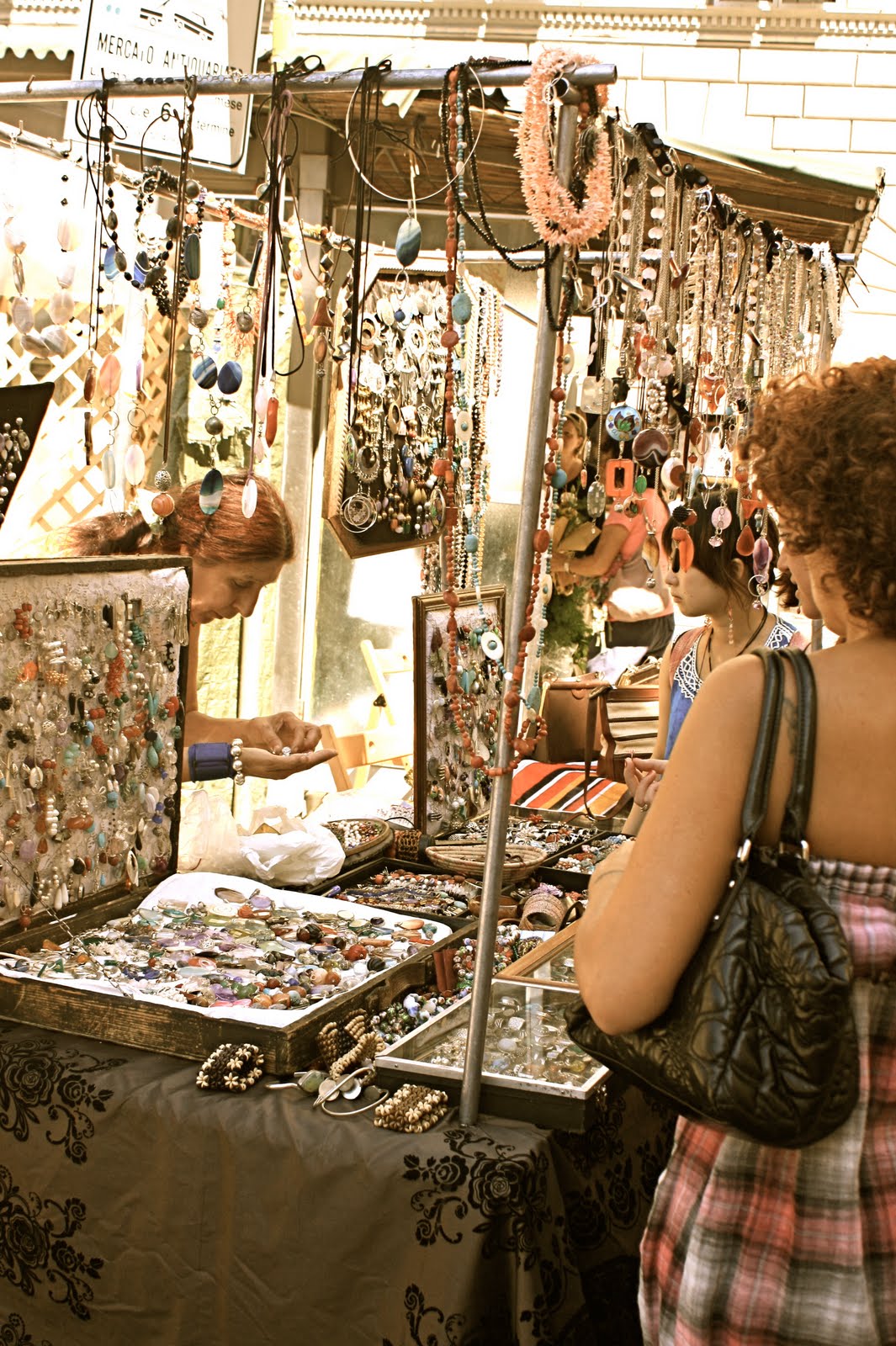
Piazza dei Ciompi between Santa Croce and Sant'Ambrogio is a cosy square that hosts my favourite antique market the last Sunday of every month. The municipality of Florence was about to eradicate the whole market at some point for what ever reason but after one year of campaigning, the future seems to be more secured at the moment, and hopefully so, because this market is one of the greatest things in Florence.


Yesterday, I bought a pair of beautiful earrings that according to the seller were from the late 19th century, ottocento, – and even if they weren't, they are still gorgeous and unique. The whole market is full of stuff I could buy, from furniture to old jewellery (or Playboy magazines from the 1970s with Sophia Loren showing her very hairy private parts). Most importantly, you just enjoy the beautiful and curious objects and the hot autumn sun.


Saturday, 28 August 2010

Mökki Escape

"Pirkkalan kesää", summer in Pirkkala.

Almost every family has a summer cottage in Finland. After the Finno-Russian war even the working class could afford to buy a piece of land and build their own cottages where their children and grandchildren are now enjoying peaceful moments in the summer time. It's a cliché but the Finns really like their own peace. Some people might know their countryside neighbours but the relations remain discreet, we don't want to bother our neighbours and, most importantly, we don't want to be bothered by them. Indeed, somebody rowing closer than 200 metres from our beach is considered as an intruder. My Grandmother bought our summer cottage (=mökki) by the 7th biggest lake of Finland in the 1970s and I have continued spending my summer holidays there since I was born.


Before leaving Finland in August, I wanted to go see my Grandmother's old summer cottage in Pirkkala, 10 km away from my hometown Tampere. It was a house built for her father in the late 1920s and my Grandmother had sold it in the 1970s when she wanted to have a house with own beach instead. I had always heard stories about the house and I had a clear image of it in my mind, I had also seen some old black and white photos of it that make it look like the most idyllic place on earth, just like in the old Finnish films. We took the old route to the summer cottage. We passed by an old industrial area where the first Finnish Coca-Cola company among others had operated. At one point, the road was closed but otherwise I got a pretty good idea of the road my Dad used to bike between Tampere and the summer house.

The grass had grown long and wild but the sauna still looked fantastic.

When we arrived, the first thing I saw was the old sauna and garage. Still in perfect shape even though they hadn't been in use after the property was sold some 40 years ago. The garden was getting pretty wild and I saw my Dad getting a bit nostalgic: "This used to be our badminton yard." Now you could mostly see a place to use scythe, but there was also great charm still very present. The house was exactly as I had imagined, beautiful white wooden house that I would have been ready to buy immediately if they hadn't built a row of houses just 20 metres away on my family's old land, what a shame. It has been there useless and most probably it will be demolished in the near future. My Dad had painted the roof in 1969; it was a punishment for bad behaviour my Mother told me (they had met a year earlier in Germany so also my Mom knew the place), while my Dad said it was for a lack of summer job that he had done it. "A difficult job." But it still looked almost freshly painted.

This is just like my dream house. Look at the beautiful windows! In the attic there should still be hidden an old rifle my Grandoncle had brought with him from the war in the 1940s.

The noise from the new road reached us in the feral garden. The house of an old neighbour had also been left unoccupied recently. It was all somehow very very sad. Even if I didn't have any direct contact with the place, I felt something had been lost.

Old photos from my Grandmother's photo album. In the corner, the house is photographed in 1928.

Saturday, 21 August 2010

Getting Emotional with My U2 History

I've never really been a devoted fan of anything and I've never had real idols except maybe for my powerful and modern Grandmother. When my friends were having anxious feelings about Leonardo DiCaprio or Jared Leto at the age of 15, I was desperate to know how does anxious feel. However, I remember when in 1997 U2 brought its Popmart tour to Finland. My sister went to Helsinki to see the concert but I felt too young to go alone and therefore remained home listening to their albums and regretted not going. For more than a decade, U2 has been the Band that I have wanted to see more than any other group. Yesterday, it indeed was a Beautiful Day, when their 360° Tour arrived to the Olympic Stadium in Helsinki. Being part of the 50 000 people mass was an amazing feeling and I still can't think of any other band that could offer such a great satisfaction.

I was getting emotional already when seeing the huge stage construction, while I have to admit that U2 has enough charisma and excellent songs that it could do without any special effects. After some trouble with the screen, the audience was getting crazy and waving their white and blue scarves when David Bowie's Space Oddity brought the band members to the stadium. After an instumental intro and Bono jumping around the stage, they started with Beautiful Day. I felt some tears running down my face and thought of the Beatles concerts where girls were fainting and crying, I wasn't quite there yet but I understood a bit better the emotional aspect of such mass happenings. When 50 000 people are waving their hands or singing out loud when Bono asks them to, it is a somewhat unique moment.

They continued with New Year's Day and it took me back to one New Year's Eve at the end of the 1990s when we listned this one song the whole night through. I was sleeping under a sofa table after a house party at my friend's place. My friend had her own house already at the age of 16, not a good idea as she didn't have a great control over her own life. She died 4 years ago, and though I had lost contact with her a long time before that, the song brought me back some good as well as sad memories. However, I mostly connect U2 with my exchange year in Aix-en-Provence: we were a great group of 4 friends and after the year in France we did a road trip in Corsica listening to U2 and REM on the beautiful coastal roads. These are only extremely happy memories and I wish I could have listened One rather with than without them.

They played all the songs I was waiting for impatiently for the last 13 years. Sunday Bloody Sunday, my favourite U2 song at high school (and maybe still today) started with the recognisable drums. I tried to sing along but I had already forgotten the lyrics even if I had translated the song into Finnish for my English class' portfolio. U2 was important for my English already before this when my sister recorded me a C-casette with Numb. It's an unusual U2 song but I loved it at the age of around 7. "Don't piss in the drain" I sang along (no, they didn't play it this time).

Photo by Miikka Pirinen.

While I'm not exactly sure if actions of famous people are purely sincere, I appreciate the fact that they try to use their power to raise awareness and influence political leaders or individual citizens. U2 dedicated the concert to Burma's opposition leader Aung San Suu Kyi, and Amnesty International brought candles to the stage while the tv screen was providing us more information and powerful images. It was slightly cheesy (even though I've just heard that cynicism and pessimism aren't cool any more) but if even one or two persons in the audience got the message and were encouraged to do something, it might already be a good start. I was happy to think of my monthly donation to Amnesty International.

And do you remember when back in the Middle Ages, people used to wave their lighters in the air during some slow songs. Well, nowadays, you don't need to feel temporarily bad of not smoking as a camera is as good as a lighter. At the end of the concert, Bono invited everybody to turn on their cell phones or cameras, and the stadium transformed into an amazingly beautiful night sky with thousands of stars. By this time, I was influenced by their greatest songs and their peaceful message and I got to draw my own conclusion: while my cell phone alone only illuminates a small patch, a crowd of 50 000 simultaneously performing the same act made it something very beautiful; while my actions alone might not make a difference, together with other people they can turn into something great and important.

P.S. In Moscow, the cooperation between U2 and Amnesty International caught the interest of the police as well. When Amnesty was collecting signatures to support prisoners of conscience and urged the government to investigate on the death of the Russian journalist Anna Politkovskaya, the police detained 5 activists and obliged them to remove their headquarters (see for example the Guardian). Obviously U2 is having too great an impact on people to act for human rights... I was probably underestimating when I thought that a few people might get influenced by U2's message, already my sister was considering of becoming a monthly donator of Amnesty International after the concert.

Tuesday, 10 August 2010

Ever Fallen in Love

Summer holidays are now over, but piano, piano as the Italians would say, no hurry. I have to switch on to working mood smoothly after almost one month of Finnish summer activities. Today, I made some progress. I turned on my computer with some reluctance and with some hazy concentration I read 6 pages of a document I should revise. Finally I decided that I needed some tea (morning's golf tour was probably tiring my mind...).

During the following free hours offered by my tea break (and then it was just too late to work anyway), I browsed through last year's women's magazines that are piling up in all the tables of my parents' house. I don't follow music blogs and I don't listen to radio, so I'm usually very unaware of what's happening in the current music business. Indeed, I have to admit that I sometimes get good hints from Me Naiset, a magazine my mother reads. This time I discovered Noisettes, a great British trio with a leading female singer who is not only incredibly beautiful but also has an amazing voice. I fell in love and bought their album immediately (oh, the greatness of iTunes).

One of their songs is a cover "Ever fallen in love". I only knew another cover of the song, also a very good version of it by the French group Nouvelle Vague. The original actually dates from 1978 and is written by Pete Shelley and performed by his group The Buzzcocks (never heard). In Wikipedia I found out that also a Finnish version of the song is made, titled as Neiti C (by Punk Lurex OK, never heard). The original one is slightly punkish and, in this case, covers are much better, but I can't really say which one I like more, Noisettes or Nouvelle Vague. Here are the three versions.


And tomorrow I'm really planning to work.

Wednesday, 4 August 2010

My Running History

When a discussion turns to physical activities or sports classes at school, it doesn’t leave anybody quiet. In most cases, looking back on those events doesn’t make you wonder why you haven’t skied during the last 15 years. I still remember very clearly the turning point when I learnt that any kind of athletic activity wasn’t my cup of tea. Every year at school we had a cross-country skiing competition (now I honestly think that all sorts of sports competitions for kids under 10 years old are a product of teachers’ sadistic mind), but the most important one took place when I was 7 years old (that is, my first skiing competition). I used my sisters’ old and miserable skies, called “Lasagne”, and indeed nomen est omen, the skies got stuck in the snow and even when going downhill I needed to push myself forward. I was the last one. I hated sports. I hated sports for the next 12 years that I spent in the Finnish school system.

Almost 20 years later, I thought I could start practising for a marathon (isn’t this a requirement for any successful person in today’s society?). I was living in the posh 16th arrondissement of Paris and my professor gave a programme to exercise for a half-marathon. I began with 30 minutes. My old sport shoes (yes, I actually had a pair) gave me painful blisters but instead of giving up I used a third of my lousy trainee's salary to get a pair of Asics. I obeyed the programme and increased the running minutes even to 2 hours. I ran in Bois de Boulogne, equally popular for runners as for prostitutes. I didn’t mind the swaying vans or the cars stopping to negotiate a price with the prostitutes, the wood was a beautiful place to run around. I wasn’t yet ready for a half-marathon when the autumn came and I returned to Turku where the cold rain took over my motivation as a runner.

I started running again in Florence with the suitable weather conditions. First I ran around the stadium with many other runners, but when I moved to the centre I started running uphill to Piazzale Michelangelo where I ran through the tourist crowds that come to see the amazingly beautiful view and the copy of Michelangelo’s David. The view was a pleasure for me as well and I have to admit that I liked to show the tourists that what they came to visit from abroad, I saw every day even when doing sports.

Running in Berlin was more like my Bois de Boulogne experience except that prostitutes were replaced by the drug dealers in Hasenheide Park. While observing the prostitutes and drug dealers was interesting in both places, in Berlin hanging around in some of the cool cafés was more interesting than running in general (not that there are no cool cafés in Paris, but in Berlin I could actually afford them as well).

Listening to the same “running music” playlist, I also got to some weird suburbs in Boston. When Rammstein shouted “Du Hast” in Florence, I was somewhere close to the river or running downhill through the woods; when I heard Rammstein in Boston I was following a long stretch of asphalt street that took me past gas stations and ugly apartment blocks. I only went jogging once in Boston.

Now, in Tampere, the same playlist took me to a supermarket, then past a place where we had scout meetings, through a field where they have built some new houses recently, past the hill where I got stuck in the skiing competition, a little pond where I played after school with my friends, to a playground where they have replaced the cool (and probably a bit dangerous) carousel (man-shaped, a bit like giant whirligig) with some boring (and probably safer) basic playground stuff. I had run really fast in the hot afternoon and at home I threw up. I think I will never run a marathon, instead, I think Nordic walking is great if only it was acceptable (or not embarrassing) for young people or in the urban setting (so far, I have only practised it at our summer cottage in the countryside).

Tuesday, 29 June 2010

Crémant and Krugman in Luxembourg

I spent one week in Luxembourg in a workshop on income distribution. Even if it might sound ironic, Luxembourg hosts a vast data bank of income statistics (LIS) that provide a great setting for studying income inequalities across the world. This year, a 2-day conference on middle classes was integrated into the workshop programme. I was especially excited about a keynote lecture by professor Paul Krugman. I'm not so interested in his macro-economic models on international trade for which he won a Nobel Prize but rather I know him from his New York Times columns in which he fiercely used to criticise the Bush government or talks about economics in popular (but always insightful and sometimes even funny) terms. If you check his blog The Conscience of a Liberal, you will find under the topic "Inequality and Crises" (27 June) the powerpoint show he used for his presentation to us. In a later entry from 30 June "The Icelandic Post-Crisis Miracle", he gets inspired by a presentation of an Icelandic scholar in our conference.

He didn't say anything fantastically new (and he is by no means a specialist of income distribution) but his thesis about the connection between inequality and economic depression was interesting and he also provided data to back up his theory as historical data shows that increase in inequality (measured as the share of total income owned by the top 1% of income distribution) has (always) been followed by depression (however, this has happened twice in the recorded history so making sound analyses is somewhat hard). Basically, there are three ways how to explain their relation. First, the connection is a pure hazard. Second, inequality and economic depression may have a common cause, for example neo-liberal ideology. Or third, inequality actually causes macro-economic instability. Krugman focused on the second possibility and tried to provide evidence that the neo-liberal or republican policies have simultaneously led us towards a more unequal society and more vulnerable economic system.


Krugman's lecture took place in Arcelor-Mittal's (the huge steel company) headquarters in an old palace where the audience included some royal members of Luxembourgian duchy and some elite members of the country. The workshop participants were remarkably underdressed, but at the reception after the lecture, waiters poured us crémant (the bubbling wine of Luxembourg) with no discrimination.


Of course we were all childishly excited about Krugman (first observation: oh, he's short). Some of us bought his book to later get a signature in it (I regret that I didn't) and we all got in a group photo with him (very exciting). On our way to a conference dinner, I had the opportunity of making him laugh – not directly speaking to him but telling a joke loud enough so he could hear it as well. A young American researcher got to sit next to him during the dinner and afterwards, her eyes were shining as if she had just met the boy of her dreams. But I guess that seeing Matt Damon jogging in the Central Park still goes ahead of this intellectual event...

Friday, 25 June 2010

Countryside Escape

As I complained about the clichés in Kirsi Piha's book "Medicien naapurissa" about her countryside house in Le Marche (Peter Mayle and Frances Mayes in a less romantic Finnish way), I was mentioned that I have also fallen for some clichés in my blog entries. I have to admit that it is hard to write about Italy without some clichés or stereotypes (and, though it might be hard to believe, I'm not a professional writer). I don't consider myself as very biased when it comes to Italy, rather I'm very critical about the country's politics, gender equality and Florentines' manners towards foreigners. I think I understand (at least most of the time) when I can't be overly positive about the Italians even though I often try to find reasons for their bad behaviour or excessive testosterone. Indeed, yesterday, during the Slovakia-Italy football match, I changed sides in the middle of the game after the Italian player kicked the Slovakian goal keeper in the groins with no reason. No matter how gorgeous Cannavaro looked (and he did!) or how cute Buffon was on the side of the pitch, I could no longer support their disgraceful behaviour and I can only hope that the elimination of their team from the World Cup will change their style of playing.

Montepulciano behind lavender bushes.

It is not that I haven't noticed the smell of piss on the Florentine streets during hot days or I've never faced nasty service here, but I rather deplore the ecological problems than use my time on complaining about the Italians (though I could write a word or two about their driving culture with a slightly irritated and negative tone). And even if it's a cliché, the countryside here must be one of the most beautiful places in the world, the wine is excellent and food... I just can't help talking about the good food...


After a tour in Val d'Orcia, you can't say a bad thing about Italy at least for a few weeks. During our three-day visit in the Southern Tuscany, we saw such breathtaking views and had such a great service (still off-season, locals were not yet totally exhausted by the tourists) that you owe not to complain for a while. So, in order to prove my objectivity, here's some evidence of the countryside beauty there:

Village of Montepulciano is a perfect Renaissance hill town where we of course indulged in Vino Nobile di Montepulciano, one of the nicest wines of Tuscany.

Town of Pienza, 20 km West of Montepulciano is another picturesque town founded by Pope Pius II and now UNESCO World Heritage Site.

Driving around in Val d'Orcia region through the small roads is a pleasure, at least if your driver isn't getting annoyed by the repeated "Stop!" shouts for photoshooting. Also, your rented Fiat Panda might have difficulties in making its way up the hills.

Brunello di Montalcino is acknowledged as one of the best wines in Italy. In the town of Montalcino you don't need to pay excessively to taste some.

Sant'Antimo's beautiful abbey.

Even more in the South, lies the town of Pitigliano on a dramatic site on top of a hill. It's worth going for the night view and its white wine Bianco di Pitigliano.