Friday, 15 April 2011

Election Fever

The Finns are electing a new parliament on Sunday. I've got pretty excited about the elections even if I haven't really been following the political debates in Finland. Actually, I believe it's better for my nerves considering the rise in popularity of the True Finns, the anti-immigration, anti-EU party that has nothing else to propose than negative attitude and nationalist (I'm not sure if the tone is more Soviet or fascist) art programme. I couldn't handle elegantly the stupidity of the opinions of the candidates (nor of the citizens voting). Well, the minor problem of democracy is that we get a parliament that we deserve, nothing more.


I went to vote in Brussels last week (and got to buy some Finnish delicacies, like our Easter dessert mämmi, at the same time). I had prepared myself with a few election surveys even though I was already pretty sure of whom I wanted to vote. The choice of a political party was easy as my principal concern in the world is environment (only in the second position is my professional concern: inequality). Later, I tried to counsel my Mother on the good candidates in her preferred party (in order to minimize the chances of some non-educated ice hockey player's wife...). To my great surprise, she finally voted for 'my' candidate as well. Talking about swing-voters... I guess my Father has been rolling his eyes and voted instead for someone who wants to build a nuclear plant in our backyard.


I couldn't vote in the last parlimentary elections as I was traveling in South America and I also missed European elections and some other elections of smaller importance. In fact, the last time I voted was in 2006 in the presidential elections. But as before, the whole election thing makes me want to get more involved in politics or even to become a politician myself. I think I'd be a good one in theory, but I would hate to give up my principles in order to make compromises and to win in some other issues. I would also be too honest and get too frustrated about the slow changes, stupidity and the way politics work in general. Thus, I should congratulate all those politiciens who do their work sincerely not betraying their own beliefs or moral and actually achieving something for the benefit of the society and the citizens (i.e. someone who isn't there only to vote for higher salaries for the MP's).


I've learnt a great deal about politics lately, not because I'm working in the heart of the European Union but because I've been intensely watching the American tv-series West Wing (what a great series it is!). Yesterday, I actually had a moment when I thought of the character of Martin Sheen being the real president of the USA before the image of Obama popped up from the back of my mind. It's a cruel game sometimes and not much is getting done because the incumbent politicians are constantly thinking of the next elections and pleasing lobbies and their constituencies.


Maybe it is after all more efficient to work behind the scenes, to have the powerful role of giving advices to politicians or reporting on what's actually happening in the world. Provide them with the infomation needed to decide wisely on policies, which they possibly cannot understand fully. I've probably been brainwashed during the 4 years of doctoral education, but I honestly think that research (+ a bit of idealism, a hinch of realism, and great deal of vision) should be the beginning of all policies. I just wish that researchers and academics would connect their work more closely to the current happenings and changes of our societies and make some strong political conclusions based on the empirical evidence they have objectively gathered. To follow this idea, I finished my thesis with a chapter titled 'Dear Member of the Parliament'. Not only 'why' question, not only 'how' or 'what' questions, but also the 'so what' question should be included more forcefully in all research conducted in social and political science!


Tuesday, 15 March 2011

It does matter!

Was I obsessed about coffee already before living in Italy? Not to the extent I am nowadays, that's for sure. In fact, I started drinking coffee in Brussels as a 19 year-old au pair. A decade ago you didn't find all these fancy Italian types of coffee in Finland, so when I tried the Belgian version of caffe latte, lait russe, in Brussels, I got into coffee drinking (I also learnt to drink beer here) and eventually was happy with the Finnish filter coffee as well.

But after the Italian coffee there is no going back to filter coffees or such. I have to say that I really liked the American way of having a half a litre of coffee in the morning with a muffin but when I returned back to Florence I realised what I had been missing. The Italian coffee culture never stopped delighting me. Still after 2 years in Florence, I learnt new ways of ordering coffee: cappuccino chiaro, macchiato freddo, orzo, ristretto in vetro… It was usual to order a different coffee for each person when a group of us was having the after-lunch coffee at our terrace in the hill of Fiesole (but summer-time favourite was always caffe con ghiaccio, coffee with ice). And though people back home just think that I've become a snob, it does matter!

Now I'm back in Brussels where my coffee history started. However, I'm a different person than back then - at least when it comes to coffee drinking. The often tepid lait russe comes with big chunks of sugar that won't melt into the coffee and the Belgian baristas (if they could even deserve this nomination) don't know what a cappuccino is (it's not a lungo with milk foam!). And they then serve it with cocoa powder, obligatorily. I miss those old guys working in the Italian bars, the hard-working man who creates a rose in the milk foam of your coffee without even thinking of it. There you are sipping your delicious coffee in a random bar in a backstreet of Florence, or any other city in Italy, the neighbouring customers in their dusty overalls holding a tiny espresso cup with their little finger up and tasting some miniature pastry (only an Italian worker can do something like this without losing his masculinity in the eyes of his colleagues).

Bialetti's little man ordering a coffee the Italian way, a finger up in the air.

In the cantine of my workplace in Brussels, you can order 'espresso Illy', I guess otherwise the espresso is made out of some shitty coffee. I pay the extra 13 cents. There are no Italian style bars around, no place to have a quick coffee, but well, would I pay 2,50 euros for an espresso that I got for 80 cents in Italy? I've started to be fastidious in Finland as well when it comes to coffee (or ice cream, or pasta, pizza, mozzarella, wine or anything related to cucina Italiana), but the Belgian coffee is of the worst kind. It's hard to believe of a city as international as Brussels, but even the Italian places here are serving their Belgian customers the local way.

To end with a positive note, the service in Brussels is very friendly. It might be slow, inefficient and not even very professional, but the people are indeed very nice and polite. This is harder to say about Florence where I had to work my way to be a respected customer worth a smile in my local coffee bar. On my next trip to Italy, I will finally buy myself a Bialetti moka pot (even though it will never replace the feeling of shouting the order in an Italian bar on a busy weekday morning).

Monday, 21 February 2011

Nature Overtaking Civilisation


As I wrote in my previous entry, what made Angkor temples interesting and exceptional was the tight connection they had to the surrounding nature. While archaeologists have tried to cut back the jungle in most locations of the Angkor complex, Ta Prohm temple is unusual in the way that the roots and huge trees are growing from the ruins making it a magical place to visit.


This special character has of course made it a favourite stop for tourists but despite the crowds attracted by the afternoon sun I was amazed by the beautiful golden shades in the stones and bare trees. Some tourists might have been more interested in the exact location where Angelina Jolie was playing Lara Croft in the Tomb Raider film a few years back (see above).


Also the less visited Preah Khan temple has this magical feeling due to its proximity to nature. This isn't an archaeological decision as in Ta Prohm but the temple is still waiting for restoration as can be guessed from the frail walls about to collapse.


Friday, 18 February 2011

The First Glimpse of the Ancient Khmer Empire


I'm already back in Finland from South-East Asia, but since my blog entries became scarce (or non-existent) as my departure approached, I haven't even mentioned the Angkor temples yet. And I should. It is the one must-see sight in this part of the world that everyone has heard of, the temple area is visited by hundreds of thousands of people every year (even 2 million according to Lonely Planet) and Siem Reap, the city closest to the temples has transformed into a tourist hot spot in good (great food, drinks and services) and in bad ("Miss, tuktuk, Lady, pineapple, Miss, fish massage...").

The Angkor temple site is much larger than most people think. You can easily spend more than a week exploring the ancient temples. The area is huge, more than 25 km2. In fact, one part of the complex, Angkor Thom, was during its heyday a city of one million inhabitants, bigger than London at the time (only 50 000 inhabitants). Nowadays, only the temples of the ancient Khmer cities still exist, other buildings of lesser importance were built of wood and distroyed by time and tropical weather. Thus, not much is known about the daily life in the cities (and I can remember even less). During the visit, the main interest is in Buddhist and Hindu images and the interplay between nature and Khmer architecture (and in strategies how to avoid too many tourists and too much sun).

Map of the Angkor complex (from Wikipedia). The distance from Siem Reap to Angkor Wat is around 6 km.

I spent three days exploring the area (3-day pass 40 US dollars, everything is paid in dollars in Cambodia): two days by bike (even though at the hotel they said: "Oh no, it's way too far away, you won't make it", well, during the first day I biked more than 30km and it was great!) and the last day by a tuktuk as I went to see temples further away.

Well, I did see the Southern gate of Angkor Thom in the sunrise. Then I explored the local insects for an hour in the 'suburbs' or Angkor Thom...

On my first day, I woke up at 4.50 am to see the famous sunrise (the wow-moment every Angkor-tourist talks about). I biked 6 km to the most popular Angkor Wat temple, but already at 5.30 am it was buzzling with tourists, I decided to enjoy a more tranquil sunrise and continued a bit further. I had read from the New York Times that the hill temple of Phnom Bakheng is actually great for viewing Angkor Wat in the morning light. Well, it was pitch-dark and I couldn't find the hill (later I heard that it is actually the sunSET hill). Instead, I was biking and then running around in order to not to miss the sunrise, which I eventually did. No, wow-moment. I continued biking and lost precious calm morning time (at 6 am the place is beautiful in the morning light, still cool and tourist groups haven't arrived yet) wiping the spider nets off my shoulders as I was doing my off the beaten track -tour. Sometimes, it is just better to stick to the usual routes...


However, I did made it to the main temple of Angkor Thom, Bayon, before 7 am. It has 54 towers decorated with enormous faces of a bodhisattva that embodies the compassion of all Buddhas. Some researchers say that the faces resemble the king Jayavarman VII who built the temple in the 12th century. This king seems to be the Medici of Khmer empire as he ordered many of the famous temples in the area (and the only one whose name I could pronounce quite easily).


I had missed my potential wow-moment, and I didn't had it during the three days of my visit, but Bayon was certainly impressive. Nevertheless, I couldn't help thinking that the temples built in the area were from the golden period of Khmer civilisation, i.e. between 9th and 14th century. During this time, they built great cathedrals in Europe too (Angkor Wat was built at the same time as Notre Dame in Paris). I couldn't get over the fact that it wasn't 'that old'. I guess it was this fact that somehow suppressed any possible sentiment of pure amazement. I didn't get the same feeling as I did when I entered the 4000 years old tombs in Egypt or when I gazed at the perfect ceiling of Rome's 2000 years old Pantheon. Maybe the sunrise could have approached me to Stendhal's syndrome as in Macchu Picchu when the morning haze disappeared gently and let the viewer admire the Inca ruins (not that old either, from 15th century) and the massive mountains little by little. I was slightly disappointed, but considering how high expectations I had, it's no surprise. But for sure, some of the ruins that were left to the mercy of nature were amazing, inspiring once again Indiana Jones -like thoughts. Coming soon...


Tuesday, 1 February 2011

Back to the Nature

So far, the most important lesson from my traveling in Southeast Asia has been: "Never eat bananas in Europe again". They just wouldn't taste like the delicious little bananas found in here. The other day, when I was motorbiking through Cambodian countryside around Battambang with my local guide Thaa, I got a rather more sophisticated though (following Rousseau's thinking, I guess).
Seeing smiling people everywhere in the small villages, I couldn't help thinking that the Western people's depression or both mental and physical ill-health are to some extent due to our alienation from the nature. Seeing people living by the seasons, according to the natural cycle of life, understanding (but not controlling!) the immediate environment around them felt so right; the way it should be.
Probably this sounds, to say the least, hypocrite, as I am in a very poor and underdeveloped country, but I truly felt a bit jealous seeing these people in villages (lying in hammocks, carrying wood or gathering their skinny cows from the field). Not that I want to be a peasant or anything close to it but I would like to have this tight contact with the nature. I'm fine with settling for a good-sized vegetable garden, a few hens and a goat, but growing herbs on the balcony just isn't enough. (Read from my previous blogging a year ago about the great book: "Animal, vegetable, miracle")
I remember being criticized by two friends of mine about traveling in poor countries, how it is some sort of voyerism and unethical. "You just want to see poor people and think how exotic it is..." This was the line of thinking. Having now travelled in Laos, a country among the 20 poorest countries in the world, and Cambodia, another very poor country where the majority of people still live with less than 2 dollars per day, I still can't agree with them. From the point of view of my studies about human well-being, inequality and poverty, it has been enlightening for me but at the same time I feel that tourism is one of the greatest ways for these countries to escape poverty (rather than illegal logging or growing coffee, tea, tobacco or opium for the rich countries). In fact, local people working with tourists are better off than the average. For example, I gave Thaa, my guide in Battambang, a day's job that he was greatly thankful of as there are not so many opportunities for work in the region.
I waved at around three hundred children during my nine hour boat ride from Siem Reap to Battambang, they were all very excited about seeing our boat and our blond hair and fair skin, and I can't understand how my being in a tourist in Cambodia would somehow be unethical (for god sake, child prostitution and sex tourism are unethical!) as I'm trying my best to be friendly, teach locals some English, buy more expensive fair-trade local products and give people a work. I asked a man in Siem Reap (the city next to Angkor temples that see more than 1 million tourists a year) how the city had changed during the last decade when the tourism started to take off. He replied that the change was immense, but for the better, he had a work now, they could build new roads and schools, he didn't consider the flow of tourists as degrading the quality of life in the city, so the situation was not comparable to Florence for example, the city of Siem Reap wouldn't flourish without the tourists.
Of course, as in Vang Vieng in Laos, tourism can bring some bad side-effects (drugs, stupidity, noise pollution). But for example the case of prostitution, in Cambodia (with hiv) it became a greater problem with the UN coming to the country with its mission after the Khmer Rouge years and the civil war, only later the toursits started "benefiting" from these facilities (child prostitution being a real problem in the country, Cambodia being the new Thailand in this sense). But this deserves another blog entry altogether, coming soon, maybe when I'm back home to reflect upon these issues more carefully. After all, I only have one more week in the continent.

Saturday, 22 January 2011

Meditation and Being Indiana Jones - Failed Attempt No.1

I was warned about Vang Vieng (my current location in Laos) or I just heard uninspiring stories from the backpackers about tubing and partying. At first, my plan was to skip the place altogether but its location on the Nam Song river in the middle of beautiful karst formations changed my mind.


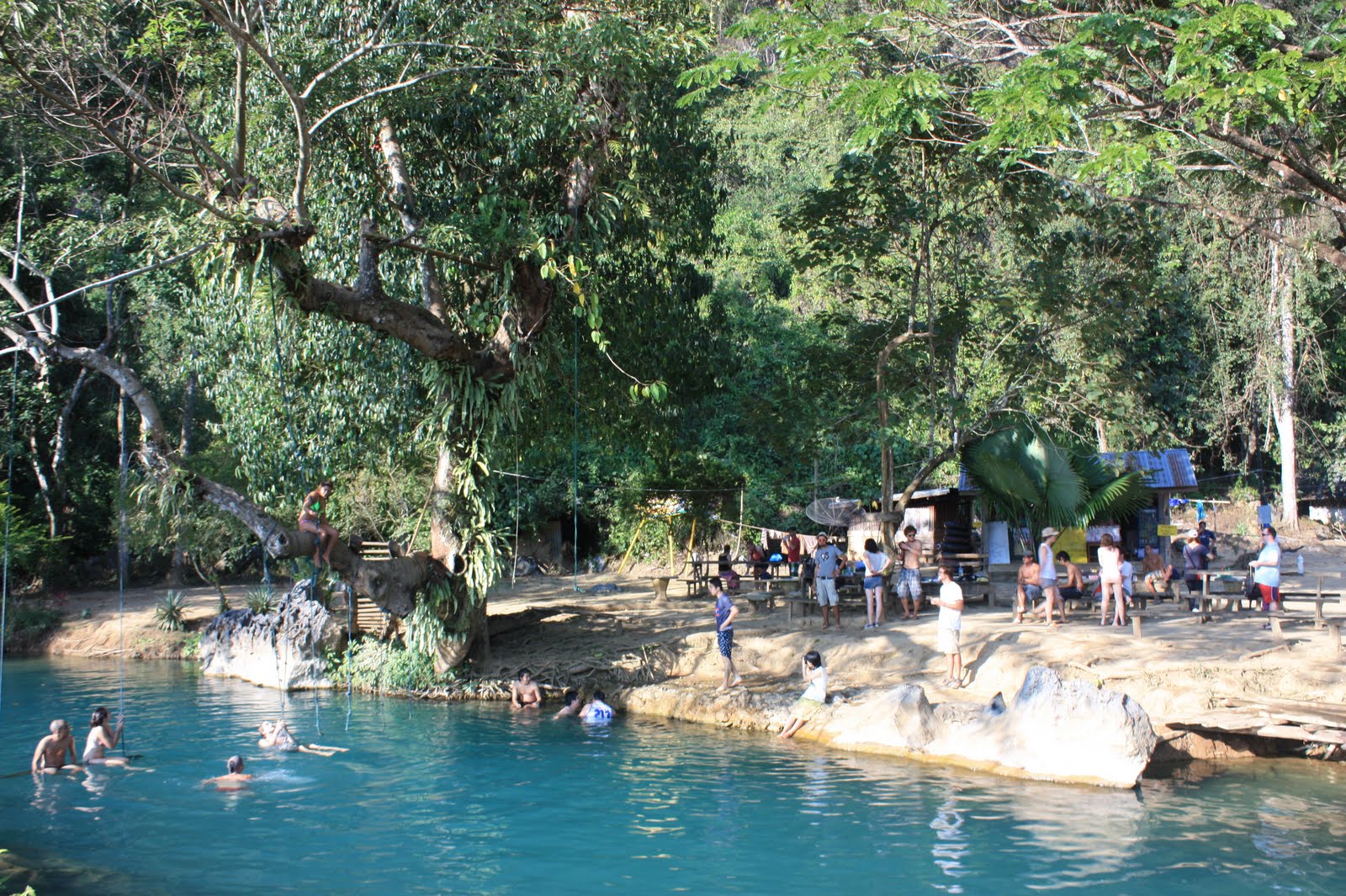
On my first day, I decided to do some caving, the second attraction of the city after tubing as the karst mountains are honeycombed with little caves and holes. I didn't have a map of the region and pretty much immediately after leaving my bungalow I had already forgotten the name of the cave I wanted to visit. I knew it was next to the Blue Lagoon but on the road I realized that most of the ponds and swimming places were called Blue Lagoons.

Signs are most often something pretty unintelligible as this.

After about 4 km of walking I found my cave. As I started climbing up the hill, two little boys were following me. They stopped a meter behind me when I stopped to take photos or enjoy the scenery, and they continued close behind when I did. I got annoyed. I wanted to have the hill for myself only and enjoy the nature alone (for company I would have stayed with the tubing people in the techno bars). It was time for a fight (they were kids, I know, but there was no way I was sacrificing my peaceful moment). I started with soft measures. I sat on a rock to contemplate the view. I read my book. I had some chocolate. I stayed there for 25 minutes but I was mostly focused on my irritation and not on my book and the boys didn't seem to mind the break and were having a stick fight. Once they got distracted and didn't seem to pay attention to me anymore, I moved on. But there they were again, one meter behind me. Time for harsher measures. I turned around so quickly that the little boys got frightened (it was war), I avoided my usual Lao style smile and pleaded them to leave me alone with a hard voice. NOW! Of course I knew that they were there for some money, to show me around the cave, but I had my own headlamp and really wanted to experience the it all by myself. They obviously got my point and let me ascend to the cave alone.

I took a step inside the cave's narrow entrance and took another step back outside. The weak wooden ladders didn't seem stable and the possible insects and little animals didn't tempt me much either (later I heard about the huge spiders and moth found in the caves). I decided to sat on a little trunk and enjoy the mountain instead, from outside. This little pleasure wasn't allowed for me however. The boys' father appeared from behind the trees. He sat 5 meters away from me and shamelessly started staring at me. I tried to ignore him and decided that this would be the perfect exercise for a meditation: ignoring his stare and enjoying the sound of nature around me. I took my shoes off and closed my eyes. As I didn't know how to start a meditation (should probably google it first), I started counting according to my breathing. I got to around 60 when I had to have a peek if he was still there. He was. Still staring at me. I closed my eyes again (with a good grip of my bag though). My meditation was however somehow distracted by the non-Buddhist thoughts of irritation. My mind was wondering from the guy to other trips I'd done to the sound of cows' bells and falling leaves (hearing the falling leaves was the closest I got to meditation, I guess) and again to some non-Buddhist ideas. The guy was coughing or shooting little stones around. More non-Buddhist thoughts. I opened my eyes, the guy was looking at me and pointing at the cave: "Cave?" Yes, I know, there's a red arrow signaling the entrance to the cave, I don't want or need your help (and I'm too coward to go inside anyway). The guy kept on pointing at the entrance. I started eating my omelette sandwich. That was my first meditation trial, I guess there's only a way to improve the control over my thoughts...

I continued to the Blue Lagoon that was neither blue or a lagoon. I didn't swim and I was slightly worried about my white skin's first contact with the bright sun (my nose is pretty red). I walked back to the main dirt road and found a sign indicating 2km to for the cave I was looking for and the "real" blue lagoon. I recognized the name. This time I completely ignored the cave and instead remained by the lagoon. Or blue-green deep river.

People were jumping to the water and swinging in the air with robes hanging from the trees in Tarzan and Jane style. I lowered myself to the river very slowly. After the day's experiences I understood how there was no spirit of Indiana Jones in me. In general, compared to the whole Vang Vieng crowd, I felt overly serious and uptight. Probably I also looked like someone really boring (but I have a PhD - almost, soon, hopefully!). However, the feeling was mutual as I had no interest in interacting with these people who had their bodies covered with "tubing tattoos" or something stupid written in their backs. And I couldn't help thinking of the Finnish proverb "stupidity grows in a group" (joukossa tyhmyys tiivistyy). Traveling alone, you observe this easily but, on the other hand, you can feel left outside. You're the intelligent one, but the one having no fun.

But this kind of fun?

Thursday, 20 January 2011

Bronze, Golden and Inner Buddhas


I guess you can't visit Laos, and Luang Prabang in specific, without some Buddhist awakening. I got mine during the full moon chanting in a beautiful temple when I was listening to the orange-dressed monks kneeled in front of a golden Buddha. It was such a tranquil atmosphere that I couldn't help imagining how much better place the world would be if all the religions were as peaceful and concerned mostly by the individual achievement of inner enlightenment (to be honest, I still have very weak understanding of Buddhism and my assessment is only based on this short period of observation). After the chanting, I chatted with a monk who had, just like all the others, just shaved his head. He recommended me meditation and even to my own surprise I heard myself replying: "I should indeed." It wasn't merely to please the friendly monk but I was actually seriously considering trying meditation. I'm inspired by the tranquility of Luang Prabang, Laos and Buddhism and I'd love to bring some of it back home as well (the bronze miniature Buddha doesn't count).

At dawn, I woke up to see the daily alms giving to the monks. The monks parade through the city and local believers give sticky rice and other food. The monks only have a breakfast and lunch so this is enough for them.

In the evening, I was too full after my great dinner in the New York Times recommended restaurant 3 Nagas, so I was unable to meditate (or whatever you want to call the peaceful moment of emptying your mind of useless thoughts and concentrating on breathing for a few minutes). The same happened again the following evening. Now, I have moved on from Luang Prabang to Vang Vieng that is sort of backpackers' paradise full of stupidity, 'tubing' in the river and drugs. My bungalow is luckily on the other side of the river, a bit further away of these people who have for some unknown reason painted their chest in neon colours. Maybe in my beautiful garden I will find the time to seek again the tranquility of temples.

Full moon chanting.

Thursday, 13 January 2011

Pace of Laos

Beautiful Lahu girl.

It took me three days to get to my destination in Laos from Sapa. In total, I spent 24 hours in a bus to make a distance of around 400 km. But once across the border, you could immediately feel that you were in a different country. The pace got slower, people smiled more and the atmosphere just felt nicer. I didn't need to travel alone as I was accompanied by a group of people escaping the cold of Northern Vietnam just like me.

Setting a banana leaf lunch table in the forest of Nam Ha national park. Menu: sticky rice, omelette and veggies.

I finally got to Luang Namtha close to the border with China in Northeastern Laos. Although I again found myself in the rain, I booked a 2-day trek to a Lahu village through an ecological travel agency. Eco-tourism is actually a big thing in Laos and half of the money coming from tourism comes from eco-traveling (meaning that a large share of the money from tours goes to local villages). The trek was nice and visiting the local Lahu people was much more interesting than in Sapa. Our communication was restricted to taking photos and showing them to the children. A Dutch women's magasine was also very popular among the locals.

Life in the Lahu village was calm, children were playing with some simple wooden toy they were throwing around, men were gone working, young girls circled around us shyly. Our greatest interest was obviosuly in the "reproduction houses" (below) as we started calling them. These very small huts were Lahu's love hotels. As the whole family lives under one roof, in one big room, the little houses were there for some privacy (we of course imagined some handcuffs, Playboy magasines, and other accessories to be found there).


Finally, after enough of rice wine ("happy water" or lao lao), the international language of music entertained as well through the evening when the whole village joined us in our hut. The small cup with rice wine went around as long as there was something to drink. Memories about the evening were only to be found in the photos the next morning; rice wine had surprised the trekkers big time but whatever had happened it made us a great group of travellers enjoying each other's company. And here I am in Huay Xai with my fellow Quebequoise trekker waiting for a boat to take us down the Mekong to Luang Prabang.