Random escapes from the humdrum of existence.
Methods used: culture, travelling, and little pretty things surrounding us. Sometimes giving way to anxiety about the environment.
When I arrived to Boston 4 months ago, I stayed in a hotel in Allston, a neighbourhood South-West of Cambridge and closer to Boston University. My first morning in this city I ended up having breakfast (blueberry pancakes, of course) in an extremely nice and relaxed coffee house Allston Café, on Brighton Avenue. I was immediately impressed, it was a café that would be a perfect hang-around place for cool characters of a sitcom. Actually, the employees of the place would themselves form a nice casting with their quirky glasses and tight t-shirts covering their skinny bodies (I take this opportunity to mention that the Harvard guys are often way too pumped up, and boy, they like to show it as well!). The music varied from folk to old school rap and the customers were unpretentious punks or some sort of artists. I was almost intimidated, afraid they might recognise that I belong to the Harvard crowd, rather than to this, it seemed to me, tight-knit community of free souls.
On Thursday, I decided that before leaving Boston I still need to have those blueberry pancakes. I put on my Converse shoes (to hide my “across the river” look) and took the bus (none of my three bus tickets worked so I finally got a free ride)pass the Harvard Business School and over one highway. I suddenly realised what I had been missing in Cambridge: this kind of crowd of different, bohemian (but still not bobo as they could be in Europe), somehow rougher and more interesting people who wouldn’t compare Harvard’s professors to those in Yale or Princeton, oh, they didn’t look like they were very much interested in what was happening in the latest sociology or anthropology research. This was somehow more real, not an academic bubble, a bit like some cool café in Kreutzberg in Berlin or “darker” side of Santo Spirito in Florence. Those people with so many tattoos and hair colours that first you seem like an outlier but once you have a chance to talk with them, they turn out to be friendly and interested in you (and not in your research).
I had my wonderful blueberry pancakes with some maple syrup. In the next table, there was a group of four guys. I recognised one of them, I had seen him there drawing the first time I went to the café. This time, I ended up having a conversation with him. He was an artist, some of the painting on the walls and in the toilet were his works. He liked drawing monsters (he actually made his living drawing monsters!) and he gave me one of his drawings with recommendations of some comic books that I should try out. I told him I was going to the Museum of Fine Arts and that I was going to leave on Monday (just before some of his arts exhibitions would open in Boston). He wanted me to indulge in my creativeness and proposed me a drawing date in the café during the weekend. It was basically his second home or his office. It was a great idea but I was too sad to call him to confirm a date. Of course, I meet somebody different just before I’m returning back to Europe. I didn’t want to regret of not living in the funnier side of the river where I could have met some interesting personalities who would have been shaped by something else than Ivy League elite schools. Instead of our drawing date, I went to buy a Harvard t-shirt today.
By the way, after a 1,5 hours of walking I finally found Museum of Fine Arts, it was great! And the last sight on my to do –list for Boston, I'm ready to return to Europe.
In 1969, an offshore oil drilling platform close to Santa Barbara’s white sand beaches exploded and spilled 100 000 barrels (16 million litres) of oil into the sea. This ecological catastrophe led to new environmental laws and changes in oil industry. One can wish that the similar catastrophe facing the Gulf of Mexico at the moment would produce these kinds of positive side effects as well. However, there are no signs that the American dependency on oil is decreasing; in fact, Gulf of Mexico represents an increasingly important domestic source of oil (one third of American oil production).
Energy issues have hit the headlines often this year. In West Virginia, 29 workers died in a mining accident recently. Then came the oil spill in the coast of Louisiana. In the clean energy side, there was the approval to build the country’s first offshore wind farm in Nantucket, close to Cape Cod, the beautiful peninsula that I visited in March. There were many protests in the island of Nantucket about this development of a windpark size of Manhattan, for aesthetic reasons. The worry of destroying the views is of course understandable and often employed in the windmill debates. But pondering the issue in the actual energy context, we must set new priorities. Do we want to spoil the oceanic view from the summerhouses of privileged people (for example the late senator Ted Kennedy was opposing the windmill park as his family has a holiday house on the seaside there) or are we more concerned about the ecological system of the seas and the global warming? Boston Globe’s cartoonist Dan Wasserman got the point a few days ago:
Politics are often coming far behind the civil society in fighting against social or ecological problems. The New York Times columnist Thomas L. Friedman, who is often pleading for clean energy policies, saw an opportunity in the current oil spill to change the American energy production patterns. While I totally agree with him, I think that for now the only hope (even if it's not very realistic either) is that people would themselves start thinking of the consequences of their car-centred life styles. If climate change hasn’t provoked any tangible phenomena in the USA (except for the droughts in California maybe) and is thus relatively easy to ignore, the oil slicks washing to your beach might cause some concrete worry and perhaps even an acknowledgement of its connection to the life you’re leading.
In her excellent and inspiring non-fictional book “Animal, Vegetable, Miracle” (2007) Barbara Kingsolver tells how her family decided to live a more environment-friendly and healthier life. They moved from Arizona to their summerhouse in greener Virginia to cultivate their own food. In desert-surrounded Arizona, all the food was produced far away or irrigated with the water coming through a canal connected to Colorado river that now gets drier and drier when approaching the border with Mexico (not even reaching the ocean anymore). Their idea was to avoid products that are transported from Europe or South America or even just from another state in the USA. Instead they would consume only locally produced food that is gasoline-free and also better quality – and who needs strawberries in January anyways.
The book is a wonderful melange of scientific facts, tales of family life in a farm, horrific stories how huge agri-business corporations work and how local food from small farmers is not only healthier, more ecological, tastier, but also supports life in small communities. Unfortunately, I will leave Boston before the farmers’ market season really begins, but I’ve already left bananas or other exotic fruits from faraway countries in the shop (and for health reasons I always prefer organic products here). For sure, I will write about this book again here and I truly recommend it to everybody even not living in the USA. But I also hope to find a similar book written from a European perspective, so widely it has opened my eyes about the lobbying that affects what we eat and the problems, consequences and solutions that an individual consumer should be aware of.
"Recipes for Disaster" (or Katastrofin aineksia, 2008) provides another example of civic action in order to save the planet. In the docu-film Englishman John Webster and his Finnish family in Espoo are going for an 'oil-diet' for one year, oil meaning often plastic that is in all the simple things we daily use (therefore the Websters are making their own toothpaste and shampoo for example). The film is tragi-comic but the ecological idealism wonderfully crazy.
Following Webster, Planet Green website challenges us to join the oil detox reminding that gasoline is where only half of the barrel of oil goes to! The website also tells us that "Plastic production continues to increase at a rate of nine percent per year. Scientists estimate that more plastic will be manufactured in the first ten years of this century than in all of the previous one." Below an example where all this non-degradable plastic is ending up (see more photos by clicking here).
As my academic visit at Harvard is approaching to its end, I have hard time splitting my time between work and enjoying Cambridge and Boston. On Wednesday I decided to devote my limited time to the latter. I took the metro (or “T” (train) as they call it here) to Southern Boston where you can find state archives, University of Massachusetts and JFK Presidential Library and Museum. My destination was the museum celebrating the inspiring leadership of John F. Kennedy. Obviously, an important and almost obligatory destination for someone studying at the Harvard Kennedy School (JFK himself graduated from Harvard in 1940).
I.M. Pei has designed the great building at the banks of Columbia Point Peninsula (the same architect who did the glass pyramid of Louvre). You can easily spend three hours in the museum and the views over Boston Harbor islands are also worth contemplation.
I think it is difficult to make an interesting museum dedicated to a political personage but JFK Museum was a success (see their excellent website to have a glimpse of the museum and many sources about JFK). I guided myself through the rooms following his career from being a senator to a presidential candidate and to becoming the 35th President of the USA, discovering his vast political as well as ideological legacy. The collection consisted mainly of interesting videos of his speeches, photos, and gifts he received from other heads of states. I don’t know if it was the fact that I knew he would be assassinated in a few years that his speeches seemed somehow extremely emotional and meaningful, I was probably partly reflecting on them in the context of his short presidency. All in all, the museum did a good job in turning me to a JFK fan…
The museum opened in 1979 and a new wing (also by I.M. Pei) was built in 1991. Now a huge American flag hangs there at the end of the museum tour.
Of course the 1960s were full of amazing political happenings from Cold War, discovering the space to finishing racial segregation and Cuban missile crisis, so JFK had many opportunities to make these memorable speeches in a context that in itself was something spectacular. I doubt that passing the health care bill will ever be as emotional event than the moment when the first two black students entered the University of Alabama signalling the end of segregation in the Southern states. However, JFK somehow managed to turn these historical events even more touching using excellent rhetorical tricks and words that even after 40 years make you admire him. His inauguration speech in 1961, during the craziest years of Cold War and increasing recognition of developmental issues in faraway countries, pleaded for peace, freedom and welfare with an idealism and conviction that Obama can only dream of (although you can find many similarities in their discourses, such as the emphasis on hope). It seems that America of today is far from what he stated then: “If society cannot help the many that are poor, it cannot help the few that are rich.” The speech is probably more known of the phrase "ask not what your country can do for you, ask what you can do for your country" that I heard small school kids repeating in the museum.
Skip to 4min30 where it starts to be more interesting and still relevant for our societies!
So when, after watching these inspiring speeches he gave next to Berlin wall or in Washington, the museum visitor arrives to the room dedicated to the 22nd November1963, one cannot avoid some tears emerging. He was the youngest president in the USA to have been elected and the youngest one to die.
Considering his short presidency, this part of his inaugural address seems even truer and above all, even sadder.
In last week's New Yorker, author Peter Hessler writes about how it was like moving back to the USA after living in China for a decade. He enjoyed again listening to Americans telling stories, whereas the Chinese never lingered on interesting details or took pleasure in narrating a good story, in general they avoided personal topics. Instead, Hessler noted, there is no “reliable” small talk in America, any discussion can turn out to be personal, even tragic. I remarked the same thing when I was attending course on poverty and social policy at Harvard. I was more interested in the interaction in the class and how students perceived the issues we were tackling than learning about American social policy programmes. Personal stories and anecdotes about their experiences were common when they were articulating their opinions or questioning the efficiency of country’s social policies. These were often stories that I would have been very surprised to hear in a classroom in Europe, stories that people would consider too intimate, or even shameful secrets, to share with forty other people. One girl didn’t hide that she was a teenage-mother that used to live on welfare (the most stigmatized thing you could think of in America), another girl told us about her growing up in family with substance abuse problems. Maybe they actually were proud of these stories: “Look at me, I was disadvantaged but I fought my way to Harvard!”
This discourse on working your way to the top is unfortunately not imaginable to all Americans. My friend’s American flatmate here told us (European audience) about his background during our late-night dinner. He grew up in Brooklyn where schools are of extremely bad quality and, while many people continue to state college afterwards, he was one of the very rare cases that had advanced to Harvard and MIT, the best universities in the USA. His success in climbing the social ladders was part of luck, good behaviour, and involved parents; some of his smarter classmates lacked especially the last ingredient and didn’t make it as far as he did. It is not just a matter of standing out as a potential Harvard candidate that actually can make you one. When he met other students from Brooklyn in Harvard, he knew that they studied in private schools in Manhattan.
We, as Europeans, were extremely curious about his experiences and the environment in his Brooklyn school. What shocked us the most was the presence of police in the school and the interventions by criminal justice system. He told us about a girl who had scribbled her name on the desk with a knife and was prosecuted of vandalism. At the age of 13 her future was partially determined, with a criminal record, she could never have federal funding for further education; any social mobility would be really difficult after this act of vandalism. Around the dinner table, we were thinking that maybe we wouldn’t have come this far if we had faced similar control at school, if our intellectual capacity had been neglected due to actions that are not that unusual for teenagers. Was the policeman thinking that he was deciding of her future, did he care? The restrictive environment, where the fear of violence increased the teachers’ authoritarian behaviour and possibly unnecessary police interventions made school yet another prison for children who often came from poorer or otherwise disadvantaged families.
The American dream didn’t sound like a possible future for these children. In fact, the upward mobility seems possible only for middle-class children who have the necessary resources and support to make the “good” decisions. I’m not saying that things would be so much better in Europe. If you are born in a Parisian banlieu you are most probably stuck there for the rest of your life. But I guess the examples we discussed showed the contradiction in the American culture where people believe in hard work and equality of opportunity. If you don’t succeed, if you end up living on welfare, it is your own fault, you’re lazy – and you are stigmatized. In contrast, in Europe, many believe that it’s structural problems, government’s bad policies or lack of initial resources that make people “fail” and live in poverty, blaming the individual is less common (while more and more used in right-wing rhetoric). Thinking of the Brooklyn school, I can’t help but wonder how these children could be empowered in a system where they are controlled and often treated as potential juvenile criminals, if their families can’t provide them any resources, how could they fight their way to better universities, even surviving through high school is impossible to so many of them (drop-out rate is around 50 per cent in Brooklyn according to our friend).
I just watched the amazingly terrifying documentary film The Cove that won the Oscar award for the best document of 2009. It certainly was an inspiring film and develops perfectly the theme I wrote about a few weeks ago, namely the animal rights of marine mammals. The film follows, in a half thriller-half conspiracy theory -style, the killing of dolphins in a little village in Japan where the sea water turns into red from September to March when 23 000 dolphins are slaughtered. As the film makers themselves say, they collect their own "Ocean's 11" (name couldn't fit their job any better!) with underwater cameras and two freedivers to gather evidence what is happening there.
While Japan's economy or culinary diet is not dependant on dolphins (or on whales for that matter) it refuses to ban this brutal activity or even tries to cover it up. The Cove shows well the politics behind the attempts to protect these animals on the one hand, and the insistance on "cultural tradition" and over-fishing of the oceans until they are empty, on the other.
Ric O'Berry who is the "hero" in the film partially blames himself for starting the fascination around dolphins as he was the dolphin trainer for the famous TV series of the 1960s, Flipper. After working a decade for the dolphin captivity industry, now a multi-billion business, he has since been working to free these animals. And after seeing The Cove, you really don't feel like going to Miami Seaworld (I've actually been there in 1992) - or even Särkänniemi's Delfinaario - where O'Berry worked and captured the dolphins for Flipper.
Below, you'll find the trailer for The Cove. Probably you'll be interested in watching the entire film, afterwards I'm sure you want to act, so click here for a petition (it's targeted to Obama but I guess the USA has more power in this issue than Matti Vanhanen, although in the film you can see a Finnish representative of the International Whaling Commission).
When I complain about cold weather people always remind me that, as a Finn, I should be used to it. Well, I know what is cold weather and I know it can even get colder but being born in a cold country doesn’t make me somehow immune to cold. I guess Darwinism doesn’t apply to this case or it’s just that our efficient insulation of buildings has helped those who would have otherwise naturally been eliminated survive the cold winters – so despite the Northern climate even the weakest of us have survived.
However, the Americans seem to have gone through some kind of cold-immunity selection. There is some evidence that this might be even a larger-scale Anglo-Saxon phenomenon. This was especially visible in Florence where the American exchange students wearing flip flops during the most of the year could easily be identified. While their mini-shorts were tacky and inelegant, it didn't seem to bother the Italian men that the streets were suddenly crowded with half-naked American and English tourists when the Florentines were still using their black full-body uniform. I encountered the most extreme case of this phenomenon in Perito Moreno, a glacier in Argentina, where an Australian guy was admiring the sound of falling ice in his flip flops. I’ve never really understood the continuous use of Havaianas as they are ugly, uncomfortable and made for a Brazilian beach party. But the Americans love them and their use is not compromised by winter: you can see people using any kind of sandals or ballerinas even when there is five centimetres of snow on the ground. In the other extreme you have those who are wearing their rubber boots in the perfect sunshine. Though I have to admit that my stand on the rubber boots use– black ones only and exclusively for forest use! – was shaken by the rainy season here that pretty much destroyed my Italian leather boots.
The point I am trying to direct myself here is, however, that of the spirit of spring. The adagio of transforming into a lightly clad summer person should not be disregarded. Step-by-step you get rid of the excess of your winter clothes and you adapt to the new season. You need to enjoy the warming spring to its maximum, first just thinking of opening your coat and then a week later actually doing it, taking off your gloves when the snow starts to melt, and radically changing to spring coat when you can smell the nature waking up again. The American process of welcoming the spring is much too quick, jumping immediately from their North Face coats to a mini skirts and bare legs (some people skip even the North Face period). But you need to advance gradually, otherwise you miss that wonderful moment when you’re taking off the stockings in the public toilets and get blisters in your feet by suddenly changing to bare feet and new shoes (happened today) as you don’t fully understand or remember what kind of temperature is +20°C.
For the sake of the American tradition, I have to acknowledge the positive side-effect of their half-nakedness early in the year, and that is of course the greater production of vitamin D as larger parts of their body are exposed to sunlight (if this happens already in February it might increase the risk of a flu however).
As my last note here was somewhat depressing, I decided to continue with the more cheerful Cape Cod theme.
We spent the spring's first perfectly sunny and warm weekend in Cape Cod, the hook-shaped peninsula south of Boston. Going there already in March was actually a great idea; off-season, most places were still closed but Provincetown's main street was nicely calm. A park ranger later told us that in summer, it might take even two hours just to drive through the town (and I'm talking about a town of around 3000 inhabitants).
Cape Cod has been a famous travel destination since the Kennedys spent their holidays here. John F. Kennedy actually initiated the Cape Cod National Seashore protecting around 60 km of Cape Cod’s Atlantic coast, and his son JFK jr. died a decade ago in a plane crash in Martha’s Vineyard, an island next to Cape Cod. Nowadays, you don't need to be a prominent socialite to spend your summer holidays here; around 2 million visitors block the beaches and roads alike every year.
Cape Cod's coast is lined with beautiful long beaches and the nature alters between arid dunes and sea taking over the swamps. Artists praise the sun light as more intense, more blue, just like in Southern France. Cape Cod's Cezanne is of course Edward Hopper who spent 40 summers painting in his studio here. Indeed, the landscape feels somehow familiar: light houses, cottages, and the treeless land. The colour of the sky is "hopperian" and you have a sudden urge to paint as well. And there must be demand for the art as Provincetown's main street is packed with dozens of art galleries.
Provincetown is known for its art and gay scene (the first gay bar in the USA was actually opened here) but its amazing fudge industry has not received the attention it deserves. Forget about those boring vanilla or rhum flavored fudges, I'm talking about cranberry-walnut or smarties-marshmallow fudges...
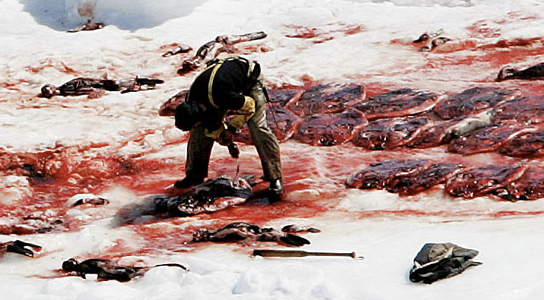
On our way to Montreal we read that the Canadian government was protesting against EU’s decision to ban seal imports. The EU thinks that killing baby seals is inhumane: during a couple of weeks in the springtime, almost four hundred thousand seals (usually less than 3 months old) are killed in Canada in the largest hunt of marine mammals in the world.
Canada thinks the EU is being silly and to prove its point, the government organized a seal dinner – this action being as mature as the baby seals they were eating. Here libreal leader Michael Ignatieff is eating seal appetizers. Even he doesn't seem to be enjoying.
Had I known more about the issue earlier, I would have never bought that Canadian lobster in Cape Cod. While I have to admit that my first lobster ever was deliciousI’ll be boycotting Canadian sea food until the slaughtering stops. If you want to sign a petition against seal hunting, go to Humane Society International.
Canada was equally cruel against the other cute white animal, polar bear, in the Convention on International Trade in Endangered Species(CITES). In the same convention, Japan’s commitment lead to the refusal to protect bluefin tuna (the proposal for protection was supported by the EU and the USA among others). Bluefin stocks have fallen by 80 percent over the last 40 years in the Atlantic Ocean and the EU had agreed to ban trade on bluefin tuna earlier this March. So, Japan boycott, anyone??
Japan also defeated the protection of sharks in the convention. Sharks represent the greatest share of threatened marine species but only three out of 50 vulnerable or endangered shark species are protected internationally. 73 million sharks are killed every year, mainly for their fins. Shark fins are considered as a delicacy in China that is the biggest consumer of sharks in the world. So, let’s add China to our boycott list (and even if you don’t care about sharks, you can add it for some other reasons; maybe protecting tigers is your thing!).
All in all, not very successful meeting for marine creatures, in fact it was more like a Tragedy of the Oceans. Despite all these sad news, we were lucky in Cape Cod when it comes to marine life. We were able to observe a troop of endangered North Atlantic right whales from a beach close to Provincetown. Around 60 whales have been spotted there and that’s good news since last year there were much fewer whales around this time of the year. We were indeed fortunate to see them because there exist only 400 whales of this specific species in the planet. And the sunset was gorgeous as well!