Wednesday, 12 September 2012

Helsinki in August - August in Helsinki

August is definitely the best time to visit Helsinki and it competes well with Berlin, Copenhagen or other trendy cities as a travel destination. Helsinki has been full of art, design, music and performances during the last couple of weeks (hence, no blog posts about my trip in Africa). To be honest, the city offers perhaps even too many cultural activities in August. The quality of the Helsinki Festival (17.8.2.9.2012) programme is always very high and I can guarantee that what ever you choose, you will be satisfied. 

I started the festival with a concert of Madeleine Peyroux, a former street singer from New York. She has a great raspy voice and makes wonderful versions of Bob Dylan and Leonard Cohen songs as well as her own songs. She started the Huvila tent concert with Cohen's 'Dance me to the End of Love' (see below); coincidentally, Leonard Cohen started his own concert (a couple of weeks later) with the same song. Peyroux made fun of her own choice of sad and melancholic songs but I couldn't think of anything more suitable as the autumn approaches us and the evenings are getting darker. Wonderful concert.


The very cool and relaxed Art Goes Kapakka (art goes to a pub) happening brings live music and other forms of art in various pubs and restaurants in Helsinki. During ten days and ten nights, there were more than 300 events (free of charge) in Helsinki. I heard some sentimental indie folk by Selja Sini and Finnish klezmer by Narinkka. Considering the overwhelming cultural supply in August, I just wish that this event took place later in the autumn when the parks are too cold to accommodate (culture-) thirsty hipsters.


As with Taiteiden yö (the night of the arts), the AGK is a great way to bring art to all people regardless of the ability to pay. The city seems to be full of people  young and old alike  eager to enjoy art in all forms. During the night of arts, I first listened to some Ugandan music, then followed the amazing Domino chain going through the streets of Helsinki (see below) and finally listened to beautiful Argentine tango songs in my neighbourhood library. The idea of the night is that culture and people meet in unexpected places in unexpected ways. It works: the atmosphere in the city was really nice I hope it could continue this way in the winter time as well.
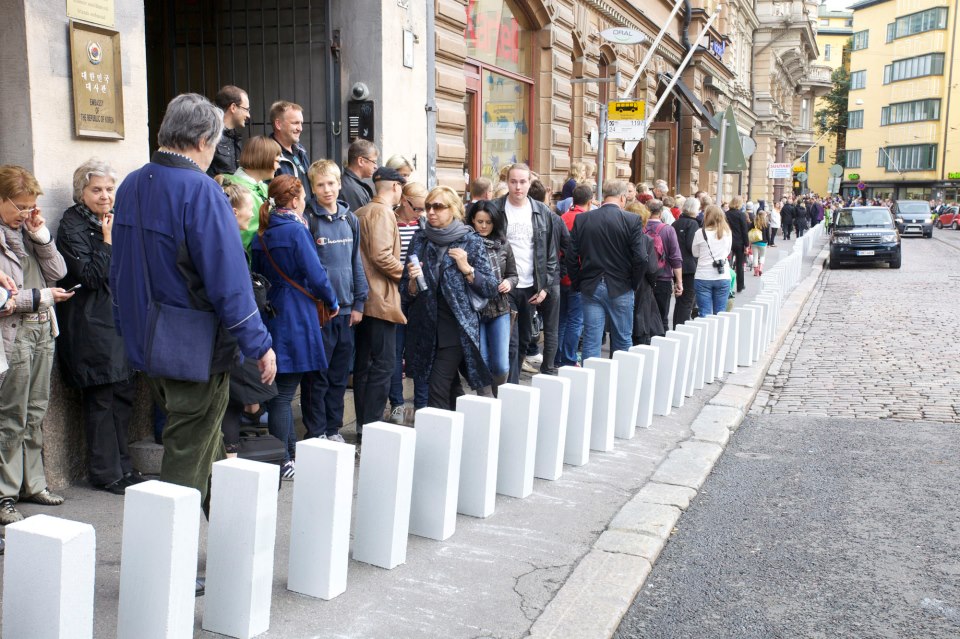
                             
All the Domino photos by Helsinki Festival (Facebook).

Certainly, the idea of the domino chain was very simple. However, the way it brought excited people together was really cool. Thousands of people had congregated in the streets to follow the chain of blocks falling down. I could hardly see the blocks when the 'chain tumble' passed me, but I got emotional (in a somewhat hilarious way) by the idea how art can create such a sense of community. Bravo!

 People following the Domino in Senaatintori.

 The final part of the Domino.

One of the highlights of the festival was the magnificent Monteverdi concert in St. John's Church. Rinaldo Alessandrini (also in the video below) conducted the Helsinki Baroque Orchestra and choir in a brilliant version of Monteverdi's Vespri della Beata Vergine from the early 17th century. I got goose pumps and tears in my eyes immediately when I heard the powerful first notes. There is a feeling of perfection in Monteverdi's music – almost as if he had received the notes straight from God. 

This music makes me believe in gods.


One great thing about the Helsinki Festival is that they introduce a lot of good artists to people who don't follow the happenings in the art world so closely. I found out about this cool young Belgian singer Selah Sue that has sold tens of thousands of albums in Belgium and France. She was indeed very talented and I'm sure we'll hear more about her in the future. She had a great voice and an original style (see below), a mix of funk, soul and rap in the footsteps of Lauryn Hill, Erykah Badu and other great female voices of the recent years.


In addition to these, I enjoyed classical music in the Helsinki Music Centre with Gewandhausorchester Leipzig conducted by Riccardo Chailly. They started with Mendelsshon's Violin concerto e-minor 64 (Nikolaj Znaider playing the violin), again unforgettable first notes (another version by Isaac Stern below) and obviously there was the sound of history and great tradition in the air as the orchestra in question was once conducted by Mendelsshon himself.


Last one of my concert experiences was a piano concert by Pierre-Aimard Laurent (below in the photo) visualised simultaneously by a British artist Normal Perryman (see video above on his "live kinetic painting"). While it was difficult in the beginning to follow both the music and the images reflected on the screen (done on the overhead projector with colourful paints), I then understood how the two forms of art complemented each other. A fabulous experience once again. 


Both photos from Helsinki Festival website.


After these overwhelmingly powerful cultural experiences, I can't help thinking of economy. In the middle of an economic crisis and budget cuts, I am extremely sorry that governments don't seem to understand the value of culture to the well-being of people and the beauty of life. More culture – less wars, unhappiness and anxiety.


It is easy to oppose subsidies to opera or theatres when jobs are at risk, but I can’t think of a more woeful society than a society without a wealthy variety of culture. It’s the end of our civilization if only profitable forms of culture can exist (Angry Birds and other video games?). It will make the selection in our libraries very poor if only best-sellers can be written (Da Vinci Code and Paasilinna?). Somehow, I wish no democracy in culture, if it means that I must read and watch what the majority is reading and watching.

Thursday, 6 September 2012

Age crisis?


I just love this cover of the New Yorker that seems so appropriate on the eve of my 30th birthday. I'm still to choose which one of the two women I identify with more.

(Just in case it needs a clarification; I obviously don't wear Chanel nor leopard patterns. But who knows if the age crisis hits really badly...)

Wednesday, 22 August 2012

Great Escape in Africa: Learning

One of the most wonderful things about travelling is learning. Something I remembered again during my last trip in Africa.

During the 22 days spent in Rwanda, Uganda and Burundi I updated and expanded my knowledge on African geography (me who once knew all the states and capitals in Africa), some bits of African history, Western geo-politics from an African point of view, colonialism, African animals and nature, African music and culture, and African politics. I'm all set for the pub quiz autumn season.

To be completely honest, my knowledge on these issues before the trip might have been a little weak. But, as I already wrote, travelling inspires and motivates me to learn more about my destination, so I filled my backpack with a biography of Idi Amin, a novel set in the times of the Rwandan genocide, a history book on the exploration of the source of the Nile in the late 19th century, the classic novel "Heart of Darkness" by Joseph Conrad, and three other books about Africa.

However, the greatest source of information was the people I met in Africa, from whom I learnt about the hypocrisy of the Western development aid policies and the double standards in the Western approach to African leaders, about their views on homosexuality and relationships, how Gaddafi was a respected pan-African leader, about white man’s burden in Africa, about hospitality and generosity, and, maybe above all, the extent to which our understanding and knowledge about this vast continent is limited.

During my trip, the list of things to understand/know better started to overwhelm me: Robert Mugabe, consequences of the climate change in Africa, how to define the source of a river (in my case the Nile), African wild animals, tea cultivation, endangered animals and fish, Swahili language, African literature, social security in Africa… It turned out that watching “Hotel Rwanda”, “Gorillas in the Mist” and some documentary films about primates was a good start but certainly not enough.

"Not only did Africa deplete my savings but it also stole my heart", I wrote as my Facebook status after the trip. The greatest ebullience has slightly faded, but I believe that my African adventure has a long-lasting effect: I’m hooked, I want to learn more and a little study trip somewhere in Africa wouldn’t be unappreciated either…

Africa colours the world.

For sure, I will now pay more attention to the news from Africa and perhaps I will buy the magazine "Jeune Afrique" more often. Maybe this blog will turn into a literature blog on Afro-lit (after a little eco-lit try-out a few months ago)... Maybe not, but I will try to write down some thoughts that I had during the trip. Obviously, I'm still working on that great Helsinki World Design Capital blog entry as well...

Monday, 16 July 2012

Summer weather complaints

 Kompassi café in Eiranranta.

I guess there is no such thing as a summer without people complaining about the weather. 

Maybe it's because I spent last summer in the cold and rainy Brussels that I have now enjoyed the summer in Helsinki greatly. I've been quite surprised by my friends and family complaining about the weather - it's Finland after all. 

Actually, today was the first day I had to use an umbrella on my way to work. At home I realised how nice it was that it was raining heavily; hearing the rain drops against the roof and no hurry to go out.  There was no need for justifications to stay inside with a beer and a good book. 

It was a good moment to go through my summer photos. As a result, here are some pictures of the sunny Helsinki to stress my point. 


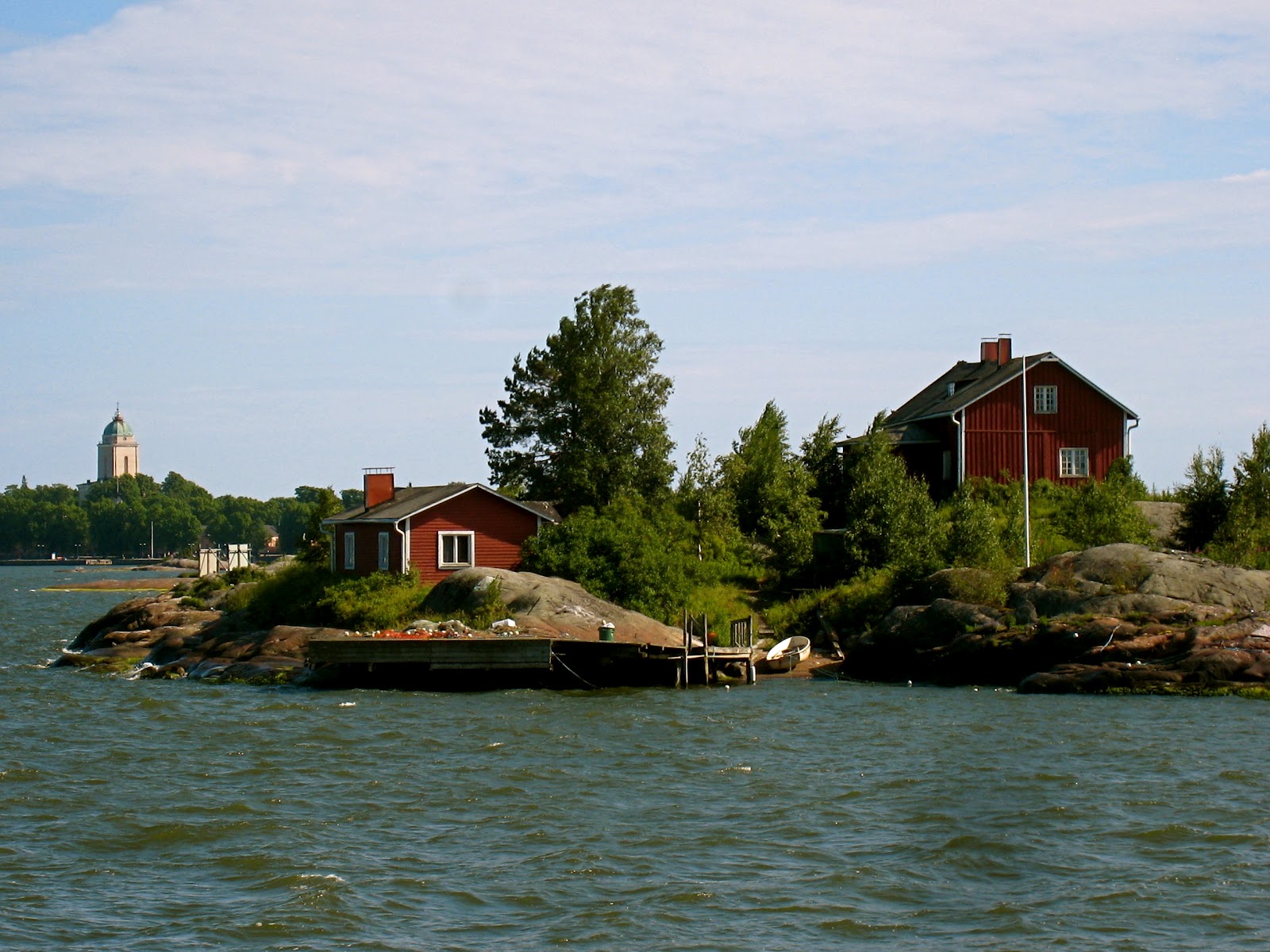
A little boat trip (4 EUR) to the island of Harakka just a few hundred meters off Kaivopuisto park. On the other side of the island, a view of the great wild sea surprised me and I forgot I was so close to the city.


                                         Island of Harakka seen from the Kaivopuisto coast.


On my way to work, I always try to enjoy the nice mornings. Peony flowers in Tähtitorininmäki.


Café Köket and the Esplanade 8 am.


One Friday after work, I did a little trip ex tempore to Suomenlinna fortress (Unesco world heritage site, a 15 min boat trip off the Kauppatori). Afterwards it was amazing that I had also worked that day. Never underestimate the power of escaping routines.


Mattolaituri where people come to wash their rugs (how do people do this in other countries?). Next to the trendy Mattolaituri terrace bar. 


Youngsters of Helsinki come to hang around on the grass between the new Music House and Kiasma museum. I'm one of them.


Market stuff at Kauppatori.


On Wednesday I will start my holidays in Africa so I guess my Finnish summer is close to its end, August in Finland is already the beginning of the autumn as the evenings are getting darker in an amazingly fast pace. New ways to escape routines need to be invented then!


Katajanokka and Kruununhaka, on my way to work.


Sunday, 1 July 2012

Summer goodies

On Tuesday, I withdrew 60 Euros from my bank account and decided to do a test on how long I could live with this amount of money. Well, so it happened that three days into the test, I had 2,40 Euros left. I discovered that it is very difficult to turn down all the summer goodies around the city. For example, on my way to work, I can hardly walk through the Kauppatori market square (see below) without sitting down for a coffee or buying some sweet strawberries... It's an excellent spot for people watching as well and definitely increases my life satisfaction!

Wednesday:
Morning coffee + macaron at Café Köket 4,00 EUR
(Already on my first test morning, my attempt to save money didn't work out. This is one of my favourite places at the moment, also because I can ask for a real cup instead of a paper cup for my coffee.)

Lunch: veggie lasagna at the cantine 5,50 EUR

A glass of wine at Kokomo 6,70 EUR
(Another glass of wine offered later at the terrace of Grotesk, a wonderful terrace I just discovered, they had excellent riesling and awful / nostalgic music hits from the 1990s.)

Thursday:
Lunch: home made sandwich 0,00 EUR
(Bravo!)

An interesting exhibition on the history of Finnish design at Hakasalmen huvila (or Hakasalmi villa) 0,00 EUR
(There's culture available also for penniless people!)

Smoothie at mbar 5,00 EUR

Friday:
Morning coffee + cinnamon bun at the market 3,80 EUR
(See below. I couldn't resist it on a such sunny and beautiful morning. It took me more than an hour to get to work as I wanted to capture the blue sky and the calm sea with my camera. So I went around Ullanlinna and Kruununhaka enjoying the summer and pretending I was a tourist in no hurry.)


Lunch: veggie paddies at the cantine 5,50 EUR

Postal services 17,80 EUR
(Unexpected expenses without which I could have survived a day or two more...)

Gin Long Drink ("lonkero") at Vuorimiehen puistikko terrace 5,00 EUR
(See below. A nice place in my neighbourhood. Although my perfect reading moment was distracted by some drunk people who emerge always with the sun...)

Ice cream at Helsingin Jäätelötehdas at Eiran ranta 3,80 EUR

And then of course, I bought new hiking boots at Halti for 159 EUR... So, the test wasn't a success but as my budget is quite tight with the Africa trip coming, I will need to learn to cut down the expenses (it means more home made sandwiches for lunch but no less morning coffees at the market square!) By the way, having little money seems to be pretty ecological as the overall consumption has to go down. On the other hand, it might mean buying less organic / other environmental-friendly products that are more expensive and opting for cheaper t-shirts made in China etc. It's a difficult question, I think I have to ponder on this a bit more and withdraw another 60 Euros and see what's going to happen to my consumption habits.


Friday, 1 June 2012

Eco-catastrophe literature

I am not so into the nowadays popular "chick-lit" (those novels like "Confessions of a shopaholic" actually give me goosebumps), but recently I've been reading some good "eco-lit" novels. The concept of eco-lit still needs to be branded though - here's my shot. (This is also my first shot of being a literature blogger.)


First I read the novel of one of my favourite authors Margaret Atwood: The Year of the Flood (2009) (in Finnish: Herran tarhurit). It's set somewhere in the future and describes a world of frightening technological developments and weird results of gene manipulation. Our near future in its gloominess is approaching biblical dimensions and the catastrophic developments have their sources in the recognizable present day developments. It is not only a story of an ecological disaster but also recounts the social division between the rich, in their barricaded neighbourhoods, and the rest (also rings a bell). The book has an Orwellian dimension in its description of private police forces protecting the giant corporation actually ruling the world (could be Monsanto...). The protagonists belong to an eco-tribe that combines in its ideology science, biblical announcements and a green way of living. The novel is actually science-fiction but the message is clearly related to the current state of affairs. Most probably for this reason its story is so fascinating and scary.


An even gloomier image of our future is depicted in Cormac McCarthy's excellent novel The Road (2006) (in Finnish: Tie). Something like a waterless flood or fire storm has swiped across the continent where a boy and his father are walking on the road trying to find food and avoid malicious bands of cannibals. Even though there is not much action in the book, it holds the reader as if watching a horror movie, the tension McCarthy has created is just amazing. While the reason for the disaster is never revealed, it is easy to understand that it is related to some man-made environmental catastrophe: the forests are burning, the roads have melted, the civilization has perished. It also poses an interesting question: what happens when the structures of the society vanish and there's no rule of law or state monopoly of violence, how can we re-organise a civilized (or even nutritionally sustainable) way of life and what makes solidarity and peaceful cooperation between people possible?  The underlying story goes to the very bottom of humanity and society. Eco-lit is pretty gloomy and, based on this novel, more inclined to cause depression than positive action... 


Here's the trailer for the film based on this book. I haven't seen the whole film but it looks like worth watching, though the writing in the novel doesn't necessitate any audiovisual guidance, I saw the happenings right in front of my eyes when reading The Road.


The third eco-lit experience of mine was a Finnish novel "Sarasvatin hiekkaa" (2005) (in English: The Sands of Sarasvati, not translated into English but there is a translated comic book based on the novel) by Risto Isomäki. This is the one of these three novels most openly about an ecological catastrophe (The Road is maybe more about the consequences, and the end of the civilization). 


Sarasvatin hiekkaa is an ecological thriller set in around year 2020: several scientists around the world are working on unrelated phenomena. However, as it turns out, things are all worryingly connected: an ancient city sunk in the Indian Ocean just like the Atlantis tale tells us, a suddenly vanished arctic lake near Greenland, gas eruptions in the bottom of the sea, a man trying to build snow-producing wind mills to prevent the melting of the icebergs. Isomäki is a science journalist and author himslef so the facts are pretty much correct and also much more interesting than the romantic sidelines in the novel. This is a description of how it could happen - how the world would come to an end as we know it; the icebergs would melt, the sea level would rise, a mega tsunami would hit the continents destroying cities and leaving people in destitution. But this is only the end of the book, the fascinating part is the "how and why". Isomäki tells the story of global warming and climate change in popular terms making geology, chemistry, marine archeology, history and geography all sound like the most exciting things in the world. It's a wonderful mix of separate fields of culture and science - and a handful of (quite well-founded) pessimism.


I need to make another blog entry about Isomäki's idea of snow-producing wind mills... or other gadgets that are actually being invented and experimented in order to avoid a catastrophe similar to the one in Isomäki's novel. They are reality, showing that Sarasvatin hiekkaa is not only science fiction.


All above-mentioned books deserve 5 stars although based on very different literary grounds. As I said, it's no light reading thematically but these were books that really stayed in my mind for a long time afterwards (indeed, I read Atwood already in August). I'm  already looking forward to my next eco-lit adventures, recommendations are welcome!

Tuesday, 22 May 2012

Just a quick note to say: sun


Forget what I wrote one month ago. Summer's in town and I've rarely been as content as now with my surroundings. I think I'm developing some kind of a crush with Helsinki. Suddenly, the city is green and people are filling the terraces and the streets (recorded during the past 48 hours: parks full of picnics, guys playing football / baseball / pétanque / frisbee, people swing dancing outside, summer collection 2012, Finnish ice cream not that bad after all, me in 100 tourist photos while sitting in Senaatintori for a lunch). Have all the cute Finns spend their winter in Thailand and only now have returned to the city? I don't understand, but this city has a double identity and I'm as bipolar as this place. I'm already missing the future past summer...

This kind of swing dancing (at least from far away it looked pretty great) was taking place in front of the National Opera today.

Actually, of all the places I've lived in or the other twenty or so capitals I've visited, I think I really prefer Helsinki (well, after Paris of course). There's so many cool things going on here, in two weeks time there has been a huge eco-design or Recycle Factory event, a flee market of the size of the whole city (called "the cleaning day") and the restaurant day when anybody can set up a pop-up restaurant in their home or elsewhere (I ate North African food in an art gallery, served by a Finnish ex-top model, and got my dessert from some Hungarian immigrants in the main esplanade of the city).
The cleaning day flee market in Fredan tori. I got a flower pot for one Euro.

P.S. This song and video is just great! I think I have to do some bachata classes in addition to my salsa classes to get those moves as well... Summer song definitely!

Tuesday, 24 April 2012

Spring nostalgia

Considering how much I miss certain places, moments or feelings, you could think I'm talking about Paris in the 60s, having drinks with Jane Birkin and discovering free love. This is not the case, it's just that in the spring time an indiscernible feeling of nostalgia emerges. I miss.

For some reason, I've been missing Boston especially lot lately: reading the Sunday New York Times in my favourite coffee shop with a wholewheat cranberry pecan scone. I don't fully understand why I miss the place, but I guess it has something to do with freedom and the endless number of opportunities that I seemed to have ahead of me at that moment. It's funny how in only two years time, I feel like I have limited my options quite drastically already - or other people have done it for me.

Last week I was in Brussels. I have a love-hate relationship with that city. The arrival is always chaotic and comes with a bitter smell of pee in the metro and train stations. In the centre, I look around and see poverty, homeless people, drug addicts and it feels like somebody could hurt me at any moment. I look down and stop smiling. It's a developing country next to the EU district and my 4-star hotel, maybe that is why the surroundings catch my attention so strongly. But there is something unidentifiably attracting in this city that I've also been missing in Helsinki.

It's not (only) the tasty beers or cute guys in Belga, the bar - together with Campari oranges - that I first discovered and fell in love with in the summer 2003. Those days the bar was full of guys wearing Lacoste T-shirts, then the ultimate brand for hip university students. However, it wasn't the Lacoste T-shirts that I had been missing (you hardly see them any more) but the possibility of meeting strangers and doing things ex tempore.

People in Brussels (just like the PhD researchers in Florence) are temporary residents, coming and going, interested in meeting new people and extending their social networks throughout the city or Europe. In Helsinki, people have the same friends they had in kindergarden, or at least for the last 5 to 10 years. The groups are tight, but it also means that it can be hard to dive in if you're a newcomer. One thing in Helsinki that has surprised me maybe the most is that groups don't mix: you seldom bring a new friend along for a dinner with other friends. Dinners and meetings need to be planned weeks ahead and few acts or invitations are improvised; it makes life a little less exciting.

In Brussels I met with a devoted Finnish scout and we went to a vernissage to which he happened to have an invitation. After a few glasses of champagne and discussions on contemporary art, I had agreed upon going to Burundi to represent the Finnish scouts in an African jamboree.

I miss it already.